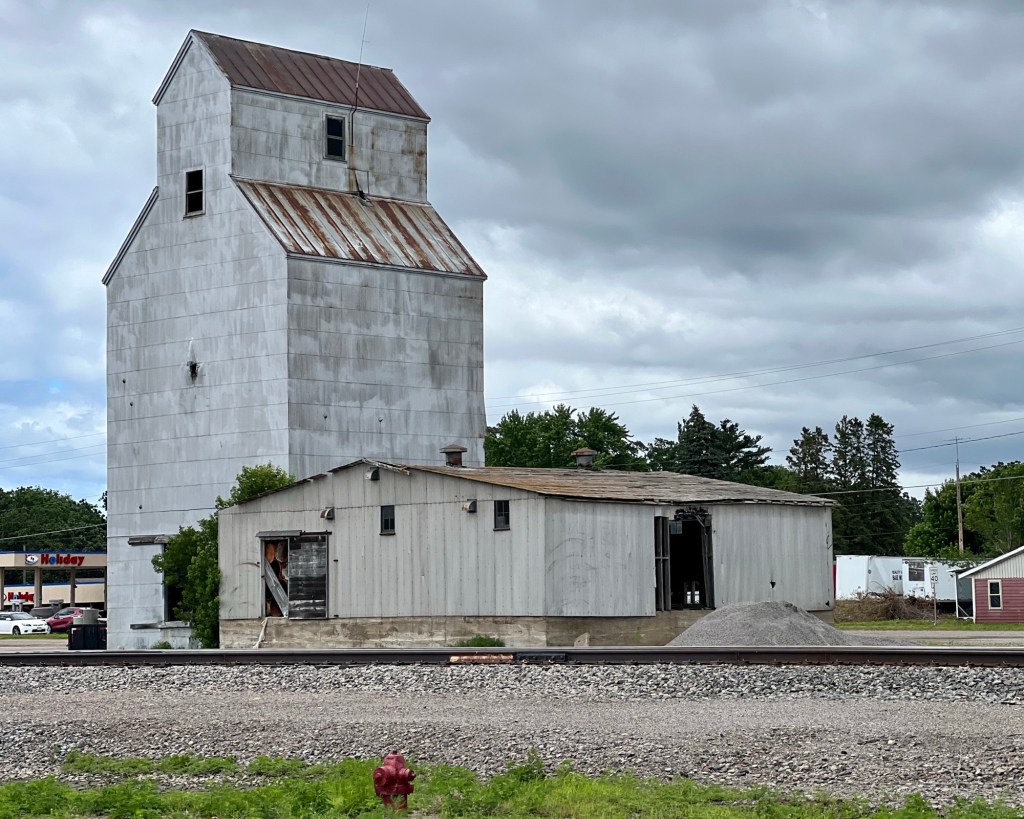
What a grain elevator could say

The grain elevator was the most ubiquitous commercial building in Minnesota’s small and medium towns during the mid to late 1800s.

In most towns in western Minnesota, grain elevators were the dominant feature of the skyline 1837 Treaty | Minnesota DNR. As railroads expanded westward in the 1870s-1880s, grain elevators sprang up along every railroad line to store wheat and other grains before shipping them to Minneapolis and beyond.

This makes perfect sense given Minnesota’s economy at the time. Wheat farming dominated the landscape, and Red Wing held the title as the world’s largest primary wheat market in 1873, exporting 1.8 million bushels valued at more than two million dollars United States v. Sioux Nation of Indians – Wikipedia. Every town with railroad access needed a grain elevator to collect, store, and load farmers’ harvests onto railcars.

Typically, small services would pop up alongside the tall wooden structures. Or an eating and drinking establishment. Sometimes a church was erected down the road a bit. And for decades, the railroad infrastructure supported a node of activity in remote rural areas.

A shift occurred once the interstate system was established in the 1950s. Rail is still most beneficial for long hauls, whereas trucks carry the grain for shorter distances, typically under one hundred miles. With fewer stops, the isolated wooden elevators fell into disrepair. Often they fell for the useful purpose of serving as a training exercise for local firefighters.

The purpose of this short vignette is to show how land uses are tied intimately with public infrastructure. And these types of projects are engaged over long time frames. A slow natural progression of the property from peak usefulness to decline can be led by aging owners, people who can view themselves in a steady state for another decade or more. The insight for the outside observer to understand where in the process a parcel finds itself. And then to implement policy in relation to the receptive impulses of that moment.

Methods for meals

Talking about methods, I noticed one method pop up on Twitter around the value of providing free school meals (breakfast and lunch) to all school children. There has always been provisions to feed children in poverty at schools across the state of Minnesota. So about 12% of school age children’s families were not charged and 88% were billed by the school. Or moms prepared lunchs and sent them out in backpacks.

In actions reflective of an exuberant majority, the law makers passed a bill to cover meals for all children. (We feed kids instead of banning books! was a slogan this year) On the face of things it sounds like a wonderful thing to do. In the world of constraints it shouldn’t be a surprise anyone that the cost of the program is bulging well past the initial number. Listen to little onion. 

Is it valid to compare the cost of free meals to the cost of police misconduct settlements? On the one hand government decided to pay food bill for families who could afford to buy their kids lunch. On the other hand there’s a number for mismanagement of a police force and the subsequent fallout. One is for sustenance, the other is for public security. The only thing to grab onto here is that taxpayer money settles the tab. Method Grade: F-.

Here’s another method to present whether the cost of increasing the school meal tab to cover all students is justified.

We note a pattern here between those who support free lunch- they value it more than funding the police. Public safety is a concern for all. Lunches are covering less than 20 percent of the population. Lack of public safety results in a loss of some kind to all citizens. Lack of school meals, in this case, means a few more PB&J’s and carrots sticks for some families. As a method, these comparisons, well, are weak. Method Grade: F-.

The Gov thinks the program is worth it since a mom wrote to him and said she appreciated not having to pack lunchs ever morning for her three kids.

At least in this method a politician was listening to a constituent. Method Grade: F+.