
A social model of Trick-or-Treat

Everyone laments the commercialization of the holidays. How tacky! How capitalistic! So why do these distasteful traditions continue to weave their way through our culture? Let’s investigate the social upsides to see if there are compensating factors.

First, it is necessary to identify the parties involved. There are the vendors of fun-size treats. These folks are unabashedly money-oriented organizations. There are parents who dutifully open their front doors and dig handfuls of treats out of their stash to parlay them into the bulging pillowcases or plastic pumpkins presented by the costumed youngsters yelping: Trick-or-Treat! These folks are subsidizers. They purchase the candy with no designs on a pecuniary return for their money. And then there are the kids. One might think they have no investment, but that’s not true. Their delight at the mystery of the evening, at the intrigue of mask-wearing, and at the innocent charm they exude is a draw to those around them.

For a proper evaluation, one must anchor the focus of discretion. This tracks which group is being considered in the balancing of accounts. Let’s start with the stores. They are commercial ventures, supplying items their customers demand in return for enough to pay their expenses and a little more. If Halloween went to the wayside, they would simply move on to something else. There seems to be very little to model here in terms of the social sphere.

Now, let’s anchor the view from the adult participants. They lay out the cash– so what do they get? They bring joy to their kids and perhaps a little to themselves. The event might rope in grandma and grandpa, a couple of worthy backstops in the activities of family life. Lastly, the business of activity on the streets brings out a Jane Jacobsian benefit. So, parents and adults can gain in private pleasure, family bonding, and community spirit.

Lastly, consider the kids. It might seem like a windfall for them. However, probably more than one parent keeps the incentives of a successful Halloween as a behavior modifier. So they too pitch in with a bit of work when it comes to supporting the holiday.

For the foreseeable future, the balance in favor of the social gains indicates a continued future for this spooky festivity.

Trad wives in Hollywood

In the 2020 series Roadkill, Saskia Reeves plays the wife of the ambitious politician Peter Laurence MP, played by the excellent Hugh Laurie. She is a demure and reclusive figure living her life in their home district while her husband takes care of business, in more ways than one, in London. With both her daughters out on their own, she is more interested in her music than public life. A viewer may even pity her a bit as discoveries come to light in her families history.

But this would underestimate her. As the story unfolds, it becomes apparent that she has calculated her part of the bargain in her marital partnership. And she knows how to play her cards.

A new series on Netflix, Zero Day, is much more confident in their trad wife played by Joan Allen. The wife of the former president (Robert de Niro) is a partner, an advisor, a support, a wife, and a mother to their daughter. In essence, she fulfills all the duties of a traditional spouse without any formal income or profession. Her advice is forthright. She watches and reports.

Both shows deal with managing and overcoming the strain of relationships outside of marriage. Both juggle relationships with children. And in each film, the relationships have room for warmth, affection, and what most call love. Old people love not youthful passion. She’s been gone for so long; seeing her back in public view is good.

For decades of characters like Murphy Brown- bitter and stridently looking for power and satisfaction in professional work have garnered the glamor of the entertainment business. Then there were single working moms, getting ahead and dubiously happy to be rid of spousal obligations. Hollywood has shown us every variation of power-seeking women looking for fulfillment in paid-for work. Not that there’s anything wrong with that. It’s just nice to see the trad moms return to the small screen. And as these series show, they’re not that weak after all.

Unpaid Work and More

Everybody knows what labor is. It’s the activity performed by an individual in return for a paycheck. But what about all those other activities that are done that also benefit some or many people?

I asked Chat to list all the terms out there for unpaid work done in homes and communities. And here is what I got.

1. The Home

Unpaid labor focused on household maintenance, caregiving, and family life:

  • Household Production
  • Domestic Work
  • Unpaid Domestic Labor
  • Reproductive Labor
  • Invisible Labor
  • Social Reproduction
  • Home Production
  • Unpaid Household Services
  • Homemaking
  • Housekeeping
  • Child-Rearing
  • Elder Care
  • Family Caregiving
  • Emotional Labor (within the household)
  • Caregiving
  • Informal Care
  • Unpaid Childcare
  • Parental Care
  • Kin Care

2. The Office or Other Professional Settings

Unpaid or voluntary labor in organizational, administrative, or professional contexts:

  • Pro Bono Work
  • Volunteer Work (for professional organizations)
  • Advocacy Work (unpaid)
  • Mentorship (unpaid)
  • Internship (unpaid)
  • Apprenticeship (unpaid)
  • Emotional Labor (in workplace or professional settings)

3. The Church or Other Places of Worship

Unpaid labor related to spiritual, communal, or faith-based activities:

  • Charitable Work
  • Community Service
  • Faith-Based Caregiving
  • Volunteer Work (religious organizations)
  • Advocacy Work (faith-driven)
  • Grassroots Organizing
  • Altruistic Work

4. The Community Center or Public Spaces

Unpaid labor supporting community well-being and public engagement:

  • Mutual Aid
  • Neighborly Assistance
  • Community-Based Care
  • Volunteer Work
  • Charitable Work
  • Grassroots Organizing
  • Community Service
  • Non-Market Work
  • Social Support Work
  • Advocacy Work (public or civic)

5. Schools or Educational Settings

Unpaid labor supporting education, learning, and mentoring:

  • Unpaid Tutoring
  • Mentorship (unpaid)
  • Parent-Teacher Association Work
  • Volunteer Work (schools)
  • Advocacy for Education

6. Medical and Health-Related Facilities

Unpaid labor related to caregiving and health support:

  • Elder Care
  • Family Caregiving
  • Informal Care
  • Unpaid Childcare
  • Caregiving (medical settings)
  • Volunteer Work (hospitals and clinics)

7. Farms, Rural Settings, or Outdoor Spaces

Unpaid labor connected to food production or outdoor community support:

  • Subsistence Work
  • Self-Provisioning
  • Reciprocal Labor
  • Communal Work
  • Obligatory Labor (culturally expected in rural communities)

8. Government or Civic Buildings

Unpaid labor focused on governance, policy, and public service:

  • Advocacy Work (political or civic)
  • Volunteer Work (government programs)
  • Grassroots Organizing
  • Community Service

9. Museums, Theaters, and Cultural Institutions

Unpaid labor supporting arts, culture, and historical preservation:

  • Volunteer Work (cultural organizations)
  • Passion Work (for the arts)
  • Charitable Work (for cultural causes)

This categorization demonstrates how unpaid work is intricately woven into all aspects of society, emphasizing its importance across diverse settings. (end Chat)

Although a lengthy list, I think Chat missed a few.

A notable one is the hours tinkerers spend trying to develop new products and technologies. Did the Wright Brothers get paid for their first flight?

Cracking the kid’s question

My husband and I both come from families with five kids. Even then, ours were larger families, as the average US woman bore 3.6 children. Big families were those with ten or more children. A college friend with twelve siblings scored top prize in the mega family category.

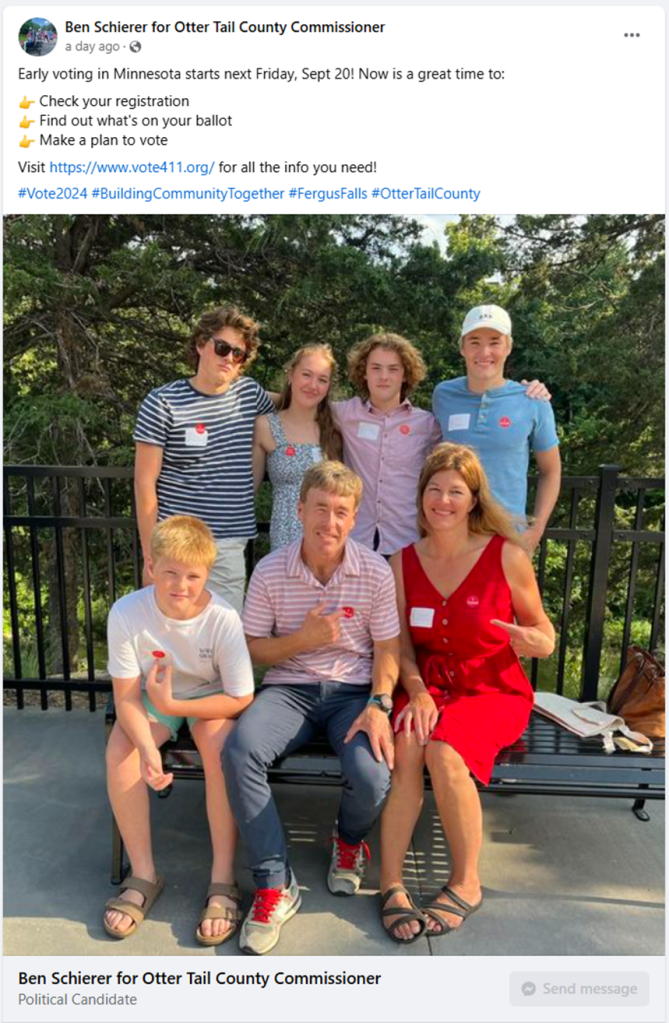
Today’s fertility rates are not even up to replacement numbers. So, what can be done to make large families fun again? One approach may be to consider them in election choices. Here’s a father of five kids running for a county commissioner position. People who live a lifestyle conducive to a gaggle of kids are bound to favor programs and support services geared that way.

Most people want similar things, such as personal safety, good schools, and adequate health care, all within the reach of decent employment. However, a large families’ focus is undoubtedly skewed to their preferences. Safety means kids can navigate city roads to and from schools and parks without harm. In contrast, a family with a musical prodigy may be perfectly willing to buffer themselves against some urban crime so their child can be within reach of the top ballet school. One wants ubiquitous small town the other wants access to specific cultural activities.

Good schools, for instance, mean good public schools in the large family scenario. It can also mean a school that isn’t too elite so that their kids have a chance to dabble in varsity sports or theater or debate without being squeezed out by intense competition. Large families form a buying group of public services. Figuring out how to match the most likely who desire a large family with the mix of services that enriches their lives is the best way to grow the population.

Patriotic Choice

James Buchanan is renowned for charting a new direction in economic theory with the introduction of Public Choice Theory. This theory emerged from the realization that politicians are not solely altruistic public servants, but may also be swayed by self-interest in their political roles. It should follow then that when a politician takes action in the form of an exchange, it is possible that that behind the choices lie blended motives. And in general, people can use trades to general a gain for the self as well as the tribe.

After all, purely altruistic action is most commonly seen between parents and their children. When exerting effort during the trying toddler years of dependency or spending down savings for higher education, few formulate a cost-benefit analysis. Perhaps in the back of the parent’s consciousness there is a thought that a healthier, better-educated adult will be a kind caretaker to their elderly parent. This deep bond between parents and children often leads to countless unnoticed acts of selflessness, like a parent waking up in the middle of the night to comfort a scared child or a child sacrificing personal time to help a parent in need. These acts of love and sacrifice form the backbone of familial relationships and lay the foundation for a strong, supportive family unit. Over the years, the selfless actions of parents continue as they guide their children through life’s challenges, always putting their children’s well-being above their own. And as children grow older, they often reciprocate these selfless acts, showing love and care for their aging parents, thereby perpetuating the cycle of altruism within the family.

Blended motives are becoming increasingly prevalent in modern society, as individuals seek to align their personal goals with larger social or environmental causes. In the workplace, many employees are drawn to non-profit organizations, where they can pursue their professional ambitions while also contributing to a meaningful collective mission. Similarly, in the realm of leisure and tourism, the popularity of eco-tourism continues to grow, reflecting a desire to explore the world while supporting sustainable and environmentally friendly practices. Moreover, in the consumer market, there is demand for organic foods and battery-operated vehicles, driven by a dual concern for personal well-being and environmental responsibility. These diverse examples all underscore the complex interplay of individual and collective motivations in contemporary decision-making processes.

This holds true in institutional pursuits as well. Recently, a juror in our area promptly called the FBI instead of keeping a bag containing $120,000 in cash in exchange for an acquittal. This act of integrity serves as a testament to the essential role that individuals play in upholding the principles of justice and fairness in society. Where would we be if citizens didn’t react in a judicious and expeditious manner when confronted with such moral dilemmas? The swift and decisive action taken by this juror ensured that the would-be bribers were tracked down and held accountable for their actions. Such incidents underscore the pivotal role that individuals play in preserving the fabric of justice and upholding the rule of law.

This democracy is made up of individuals like all the ones who will share a 4th of July picnic around BBQs in backyards today. These are the folks who, in actions large and small, blend into thousands of choices made every year, work and contribute to the ever-evolving project of America.