Cash is not always the answer

They say some things you can’t buy. Or maybe some things are more conducive to pecuniary transactions than others. Take the Violence Interrupters. By the summer of 2020, the community wanted to try a new angle on crime prevention, as an article from September explains.

MINNEAPOLIS (WCCO) — The city of Minneapolis is sending members of the community into the streets to prevent violence that is plaguing the city.

They are called the Violence Interrupters, and they’re tasked with stopping shootings by mediating conflicts in the community, and following up with individuals to decrease retaliatory violence.

Jamil Jackson and his group of interrupters are on the move.

“Our mantra is engage, relationships, resources,” Jackson said. “We’re teachers, we’re business owners, we’re city employees, we’re park employees, we’re just individuals who came to the call and had a desire to come out here and change.”

Their bright-orange shirts stand out, so they can walk in and use their relationships within the community to stop the shootings before they happen

The idea was that if responsible people in the neighborhood could step in on demand when they saw an event unfolding, interacting with police would be avoided entirely. Neighbors helping neighbors have the advantage of, in many cases, a clearer view of the issues at hand.

Others have written about this very thing, extolling the benefits of an active community busy engaging with each other across the sidewalks and parks of a neighborhood. Here’s what Jane Jacobs wrote in The Death and Life of Great American Cities.

The first thing to understand is that the public peace the sidewalk and street peace-of cities is not kept primarily by the police, necessary as police are. It is kept primarily by an intricate, almost unconscious, network of voluntary controls and standards among the people themselves, and enforced by the people themselves.

With good intentions, an office of violence prevention was created and funding was carved into the city budget to pay people in the neighborhood to step in and prevent an incident from escalating. So what happened? Fast-forward to this week in 2025.

Some Minneapolis City Council members say the city’s Neighborhood Safety Department (NSD) has been too riddled with mismanagement to continue overseeing violence intervention programs. On Thursday, three council members proposed that more than $1.1 million be allocated to Hennepin County to temporarily take over two intervention programs. 

For more than a year, council members have routinely flagged concerns over the department that administers violence interruption programs. Several violence interruption groups reported contracts that had lapsed or gone unpaid last year, which council members say shrunk safety services in parts of the city. A 2023 lawsuit also alleged the department arbitrarily awarded millions of dollars in contracts without adequate oversight. 

Things have gotten so bad that the council people, who are most vocal against professional police, no longer want to be responsible for this new form of neighborhood quieting. But why didn’t it work? It has the right components.

It’s the money.

The eyes-on-the-street people, who help keep the peace, are many and are often never called on to intervene in any way. To meter out the job to an individual is resource misallocation as it takes a large group, a whole neighborhood, of people to monitor and, through small actions, or phone calls, or gestures, alter the course of events. There isn’t enough of a job for just one person.

When resources don’t have a direct draw against them, they become ripe for fraud. Those in charge of the money have to put it somewhere. Opportunists realize this and create a demand where none exists.

Community policing is a group thing. It does not jive with the division of labor or hourly wages. Whoever is available when the car crashes into a pole and is set on fire, whoever happens to be passing by and has the will and capacity to help, are those who step up voluntarily in times of need. For that they receive an award.

Russian Doll model of public safety

Some goods are best produced privately, and some perform better in the public goods market. Production in the former is enhanced by the division of labor, whereas in the latter, crowdsourcing is vital. The recent high-profile apprehension of a person of interest in the death of a local CEO is illustrative.

Let’s break down the Russian Dolls. The largest doll is the level of law enforcement, which is officially put in place by the government and funded through taxation. These forces fall under territorial boundaries. Since the attack against the healthcare executive took place on the sidewalk in front of the Hilton in Manhattan, the NYPD is in charge of the case.

These uniformed professionals went to work and quickly found the getaway route the suspected assailant took leaving the scene. He fled on foot and then jumped on an e-bike. He went through Central Park and ended up at a bus station. The officers were fortunate to find out the suspect had spent the night at a local youth hostel (Time).

A senior law enforcement official is quoted as telling the Times that the person of interest photographed used a fake New Jersey identification to book a room at a hostel, checking in on Nov. 24 after arriving in the city via bus. He then checked out of the hostel on Nov. 29, before checking back in the next day.

The real breakthrough from this local contact was a photo of the normally masked man who had been snapped in the hostel lobby. He showed his features at the friendly receptionist’s request. A citizen can contribute to an investigation simply by following the rules of their employment.

As the manhunt continued into other states, the following levels of Russian Dolls were engaged. Even though the NYPD remained in charge of the official investigation, it depended upon the work and resources of many other branches across state lines. These details remained in their reporting realm. While the media activated public interest in the case, they kept the general public interested in the pursuit.

This brings us to the McDonald’s worker who noticed a similar-looking young man in his restaurant. He could have looked the other way. Now we are down to the last Russian doll. Not everyone at this level will engage. How many others saw the perp, became suspicious, and stayed quiet? There’s a potential cost of reporting, and not everyone is willing to take the risk.

Fortunately, the greater society doesn’t need everyone to report. Only one person needs to step up. This is not pay-by-the-hour employment; it is a job one does under the influence of a shared vision when the duty shows up on the other side of your counter at McDonald’s.

Public goods respond well to this blended model of paid personnel in conjunction with a more significant population of people who follow the norms, like the youth hostel receptionist, and those willing to take risks and report. But I do hope the McDonald’s worker gets a bonus.

Broadchurch- Series Review

I’m late getting to know Olivia Coleman’s (Sarah Caroline Sinclair) work. I saw her first in The Lost Daughter and was taken by her brilliance. A week ago, when browsing for something new to watch, the search by performer suggested Broadchurch. This series was released in 2013 but feels as fresh as more recent productions. The episodes are an hour long, my TV time allowance.

ChatGPT offers a nice summary.

Broadchurch is a masterclass in British crime drama, blending gripping mystery with deep emotional exploration. Set in a small coastal town, the series kicks off with the tragic death of an 11-year-old boy, Danny Latimer. As the investigation unfolds, we watch the town’s secrets unravel, exposing its residents’ hidden complexities and tensions.

What makes Broadchurch stand out is its commitment to character-driven storytelling. DI Alec Hardy (David Tennant) and DS Ellie Miller (Olivia Colman) are the heart of the show, both giving nuanced performances that elevate the series beyond a typical whodunit. Hardy, a tortured detective with a complicated past, contrasts beautifully with Miller, who is deeply embedded in the local community. Their evolving relationship—marked by tension, mutual respect, and occasional moments of humor—adds layers of emotional depth.

The series also shines in its portrayal of grief and the ripple effects of tragedy in a close-knit community. Beth and Mark Latimer (Jodie Whittaker and Andrew Buchan), as Danny’s parents, give heartbreaking performances that feel raw and real. Their struggle to cope, while facing suspicions cast upon their friends and neighbors, creates a strong emotional core that anchors the show.

Visually, Broadchurch captures the mood of the story brilliantly. The coastal landscapes, often shrouded in mist or bathed in dim, cold light, create an atmosphere that is both haunting and beautiful, mirroring the internal struggles of the characters. The pacing of the series is deliberate, building tension gradually as secrets are teased out in every episode.

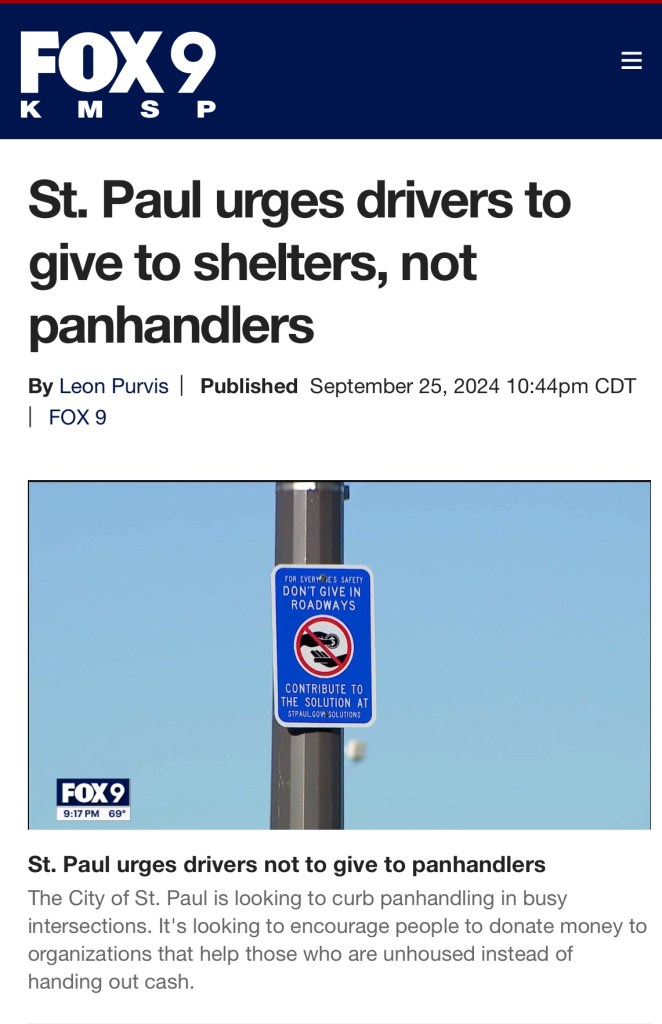
Will signs work?

I say no.

The City of St. Paul is looking to curb panhandling in busy intersections. It’s looking to encourage people to donate money to organizations that help those who are unhoused instead of handing out cash. FOX 9

City leaders say they’re doing it for public safety reasons. It’s putting signs up at intersections to bring awareness to drivers on how to help those who are unhoused. 

This is so Minnesotan. If we simply ask nicely, the good people of St. Paul will listen and do as we say! Let’s ignore incentives and inclinations.

There are two groups and two forces at work. The well enough to do in their cars are compelled at the sight of the need to fulfill an urge to act. Their instincts are crying to lend a helping hand. This is so easily accomplished by reaching into a wallet for a few dollars and rolling down a window. Searching for a reputable organization to direct funds to is tedious and not very rewarding. When you send in a check, you just get a thank you but no human touch.

Incentives for Group 1: Sign 0 Direct Give 1

The second group is the panhandlers. They have a need and are working to externalize cash from motorists’ desire for mutual aid. Although public policy types may rationalize that these folks really need this, and really need that, and it’s all because of X, does not eliminate the clear immediate need for cash. That’s their mission. The solution in the sign does not meet this need.

Incentives for Group 2: Sign 0 Direct Give 1

The sign idea does not work. If vouchers were given to motorists who want to reach out and touch someone to make a difference, and the panhandler could take said voucher to the organization for cash, among other things, then you would meet the incentives for both Groups 1 and 2. The organizations would also have a shot at ‘selling’ the panhandlers on their other services. If successful, the panhandlers would no longer need to hit the curbs with their stools and cardboard signs.

Five Minute Real Estate

In this five minute video clip, Frederick Melo with the St. Paul Pioneer Press refers to a number of important real estate outcomes. He was invited to the weekly PBS show, Almanac, due to a recent announcement that a portfolio of commercial buildings, including the iconic First National Bank Building, is being listed for sale.

The collection of buildings are owned Madison Equities. Long time real estate developer, Jim Crockarell died in January and his heirs are not interested in being landlords. Building owners can gain emotional attachment to their properties as appears to be the case here. Some of them were half empty and some completely empty. Significant vacancies do not happen on the turn of a dime. Commercial leases are multi-year and companies have an investmest in their locations. So this recent announcement reflects activity which has been brewing for a while.

Well known architectural firm, TKDA, is also moving. They are relocating to Bloomington to keep workers happy. After 100 years, the downtown devotees are succumbing to practical desires for free parking. An added feature is scenic vistas over the Minnesota River. To attract workers back into the built environment, they are seeking out new surroundings in the third largest city in the state.

US Bank is also stepping away from downtown yet still staying in St. Paul. Workers here also say no to the densest part of the city. Melo reports that the building has had ghost leases for years. While technically under contract, the one-employee-per-floor occupancy has been a long-time indicator of what the future held.

What to do with all these vancant buildings is the question of the day. The solution under proposal is converting the office space to living space. But conversions are very expensive and the demand for residential in the capital city is not as strong as next door neighbor in her sister city. It’s a tough place to live.

Grants and tax increment financing are being proposed as public interventions. Is this a good idea? I’m not so sure. The mayor is quiet letting a non-profit alliance offer investment strategies. Their approach is to focus on one street at a time. One street a downtown does not make.

Cathy Wurzer brings in the ringer of a topic just at the end. Crime and personal safety. These are real issues that have been muted in the last four years. People don’t want to have to worry about being carjacked at knife-point when they’ve got a head full of kid’s programming and an armful of work manuals. Proximity to violence is a deal breaker for many people.

I had not heard of the study the Downtown Alliance had done around the DT Greeters pre and post pandemic. Within a district where a tax was collected to support the greeter program, quality of life crimes decreased by 40%. Whereas in the adjacent Lowertown area (where the St. Paul Saints stadium is located) crimes increased by 20%. Jim Crockarell, the real estate developer, opposed the district. This is speculation, but I’m guessing he thought greeting people and being busy maintainers of sidewalk safety was meant to be organic. It was the civic thing to do. Yet here is concrete data that an organized effort to deter crime, a significant motivator, was successful with subsidized labor.

In review, we were told about multiple exits to the city core. Be careful to note this was not a sudden occurance. We heard about emotional attachments beyond the pull of financial prudence. We heard about consumer driven needs for parking and easy access. We heard about the impracticality of retrofitting the built environment (file under why so many old buildings come down). We heard about public subsidies that will fall woefully short of the task. We heard about the big driver, safety, which is often kept on the QT so as not to implicate an area.

That’s a lot in five minutes