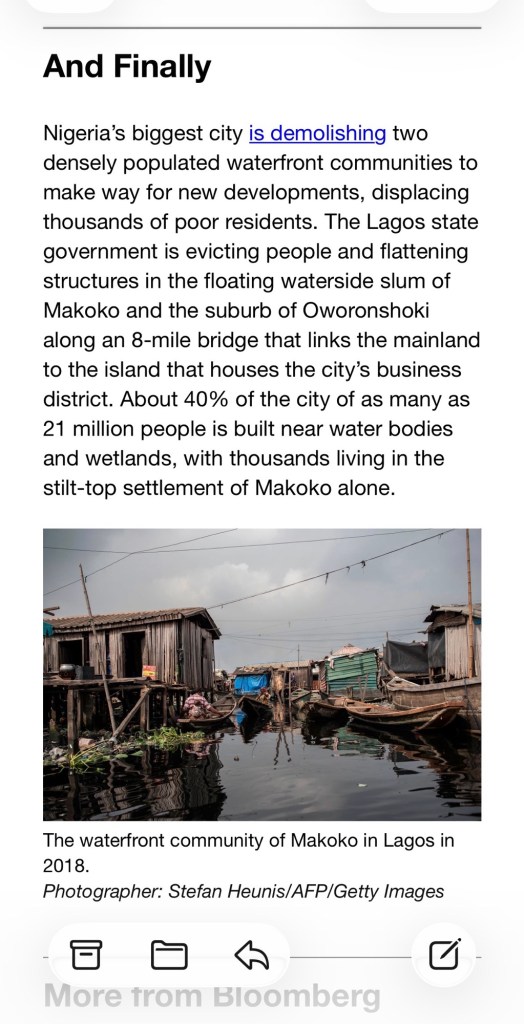
The screenshot below, from a Bloomberg newsletter, tells a story that has been told before. An area in a downtown, or alongside a river, or in a first-tier suburb, becomes blighted beyond repair. As a result, a new development is scheduled to replace it.
The question is not whether it should happen. It simply does. Over again, worldwide, across all types of geography. When the plot of land becomes more valuable for a new purpose, the natural progression is for it to be redeveloped.
On a small scale, you see it in a neighborhood when one home has been let go to the point that it does not command a price above the lot value. A new owner, or a builder, secures it, razes the structure and builds anew. At least that is what most of the neighbors desire. A dilapidated home is no fun to drive by every day. Once one property becomes blighted, it seems that others follow suit. So new is nice.
The news gets a hold of the story when a significant portion of residents are caught in this cycle, and it requires a large swath of land to turn over. That’s the story posted above. PBS covered a renovation of a large apartment complex in Richfield, The Crossroads at Penn, due to the significant number of residents were low-income.
And that’s really what the outrage is about. It’s not about renovations. It’s not about a few people who in the end are better off in a new environment for all the reasons others move: proximity to medical facilities or jobs, families, better schools, and so on. The story becomes news when the sheer number of residents involved requires more social capital than is readily at hand.
Property maintenance is expensive and ongoing. Policies that hamper repairs will yield negative returns at multiple levels. Ideally, caring for the poor entails preservation of suitable property, not its destruction.
Liberalism seems straightforward. Individuals are meant to live their lives freely. They flourish when they can follow their ambitions, or talents, or desires for a quiet life. As long as they do no harm to others, people left to their own devices can lead good lives.
All this is fine and good. But of course, we don’t live alone. We live with others. And it is at the juncture of protecting the desire for the self and the duties to the group that friction seems the most keen.
It’s perfectly acceptable for spouses to assign their liberties to each other. One takes care of pecuniary matters while the other looks after the relational part of the family, which is a common division. But sometimes the first is caught saying, “I own it all,” and the other is planning without a thought for the other. After a decade or two, one forgets what the other does for them. Slowly, without gratitude, all the small tasks enabling the freedoms they cherish are taken for granted.
The public and private often evolve into a crisis of duty.
Children easily take for granted the investments their parents made in their upbringing, especially in the US. It is easy for them to minimize what was done and begrudge them beneficial attention in their later years. Neighborhood dwellers take for granted the civic do-gooders who are responsible for small but useful things like stop signs and play lots. Volunteering to maintain or perpetuate shared services is thought of as optional.
And then, coming at the friction from the other angle, there are the enforcers. Those who wish to make every norm a rule. Instead of contributions made in sync with people’s time and talents, they wish to meter it all out and pass the collection plate with vigilance. The spirit of the exchange is ruined. Instead of thankful for the effort, people are resentful for the absence.
Liberalism maneuvers best along a framework for optimal execution. Liberalism needs a framework to avoid undermining itself from the illiberal tendency residing in most human hearts.
I’m quite enjoying Allison Schrager’s accounts of how people navigate risk in their lives. The book is full of stories about poker players and surfers, as well as bankers and bond traders.
Although the framework follows the model of an individual making a decision, in the background there are many communal references. This passage is about the paparazzi partnerships.
Since the best shots come down to being in the right place at the right time, photogs often form teams or alliances to share tips and sometimes royalties to increase the odds or payoffs they’ll be in that place. In 2003, Baez founded a group called PACO, “like the jeans,” combining the words “paparazzi” and “company.”
PACO consisted of ten experienced photographers. They traded tips on where certain celebrities hung out and when. So if Baez spotted a celebrity eating lunch at a trendy restaurant, he would alert the other PACO members. He says, beaming with pride, “Back in the day when we’d show up, the other guys would say, ‘Oh no, here comes PACO, because we were the best.”
Family ties show up in several of the vignettes. Somehow the prospects of his first love trump a degree from Stanford. When talking about the business executive Arnold Donald, she recounts.
It was a way to get both worlds: the liberal arts experience he wanted and the Stanford engineering degree.
During his sophomore year at Carleton, Donald married his college sweetheart, who also received a place at Stanford’s engineering school but no scholarship. Rather than take on the financial risk of student loans, they went to Washington University in St. Louis, where they both had scholarships.
And background players can even accumulate into a whole world of their own. For the poker player, there’s a benefit to syncing with the subculture.
The world of professional poker is a unique subculture-complete with special outfits and lingo-that appears foreign to outsiders. Its obsessive fan base watches games on television or in person for hours, is preoccupied with stats, and gambles on the players and games. Winning at poker comes down to luck and skill. Luck is being dealt a winning hand. Skill is knowing how and when to bet, and having the discipline and ability to infer what other players are doing.
Although not explicitly described or measured in terms of their influence, social relations, network effects, family ties, and workplace mechanics are ever-present in Schrager’s stories on risk.
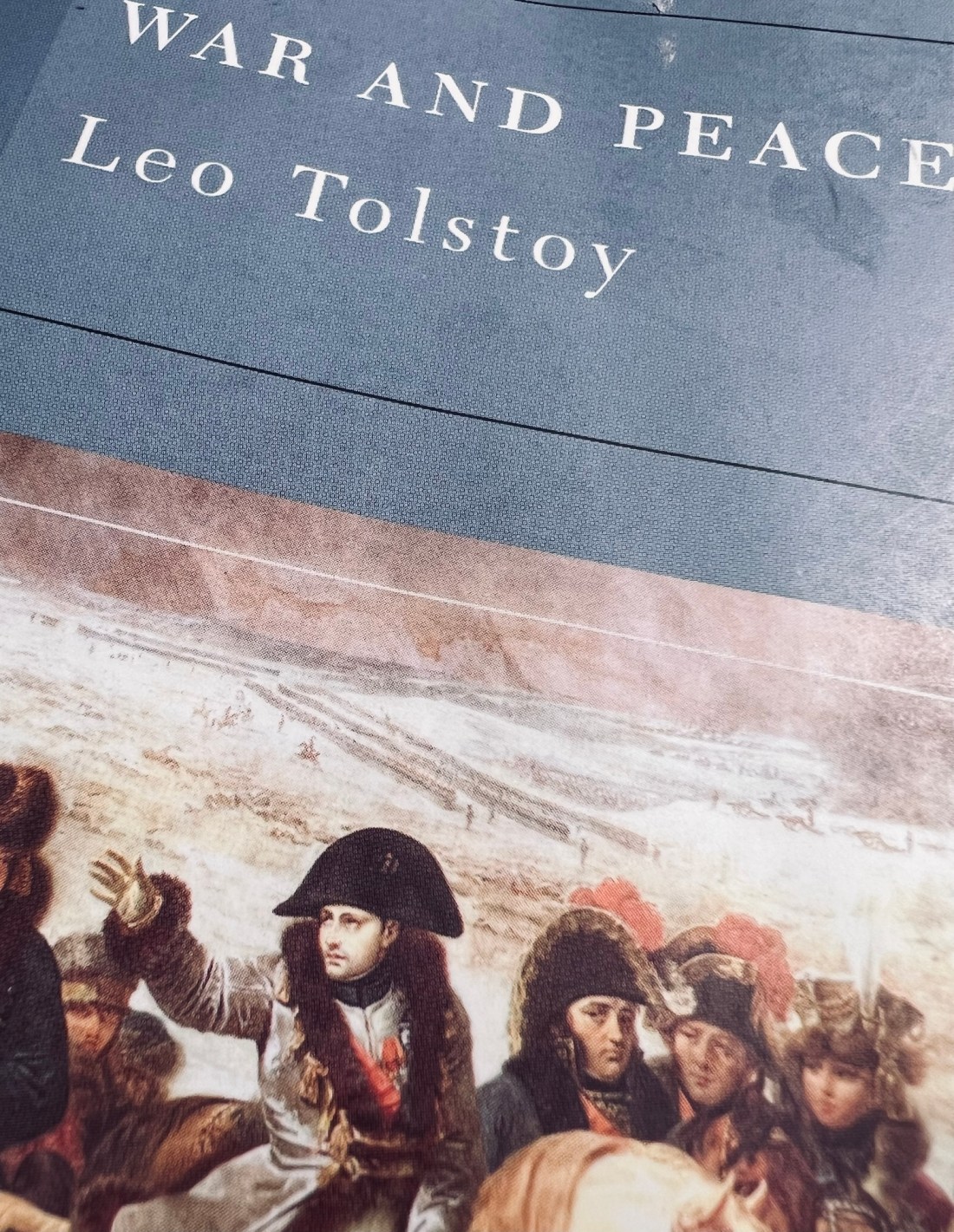
A topic under examination that runs through War and Peace is the analysis of warfare. What were the keys to Napoleon’s success? The size of the army, or the genius of the man? Or something else.
In Part 15, chapter II Tolstoys starts us we thinking in terms of individual agents.
ONE OF THE MOSt conspicuous and advantageous departures from the so-called rules of warfare is the independent action of men acting separately against men huddled together in a mass. Such independent activity is always seen in a war that assumes a national character.
The author then tells us the accepted view is that it is about counting soldiers, guns, and supplies.
Military science assumes that the relative strength of forces is identical with their numerical proportions. Military science maintains that the greater the number of soldiers, the greater their strength.
But…
Military science, seeing in history an immense number of examples in which the mass of an army does not correspond with its force.
And thus Tolstoy suggests there is something else. He wants to be scientific about this thing. He calls it X.
One has but to renounce the false view that glorifies the effect of the activity of the heroes of history in warfare in order to discover this unknown quantity, x.
X is the spirit of the army, the greater or less desire to fight and to face dangers on the part of all the men composing the army, which is quite apart from the question whether they are fighting under leaders of genius or not, with cudgel or with guns that fire thirty times a minute.
It seems that what is important here is that soldiering with X is something different than soldiering in general. To fulfill a duty with X is not the same as a run-of-the-mill fulfillment of the same task. It does not quantify in the same way or lead to the same results. Labor with a purpose or a shared ambition deserves a subscript of x.
This carefully crafted book intertwines three tales occurring around the 1961 assassination of Rafael Trujillo, the brutal dictator of the Dominican Republic. The author’s language is beautiful and descriptive. He astutely matches the voices of each of his characters to the vernacular. There are enough historical facts to learn something without the narrative becoming pedantic. All these features make it brilliant.
But I believe the author is trying for more. It’s as if he wants to answer the question: How does a brutal dictator maintain such cruel control of a country for three decades? He is laying out how it works. First, he tells us of the agents. He gives us Urania. She returns to her homeland with the sole objective of presenting her father with a tally of her expenses for a decision he made so long ago. Then there are the insurgents, working together in a high-risk pursuit. And there is the dictator who is conflated with the state, as he has all those powers and economic means at his disposal.
The author is clear that there are more units of shared interest. Each of these agents has ties to the family. And each of these has varying fortunes depending on its ranking within the social structure.
To keep his model tight, the author does not pursue the family as agents who take action. He keeps to three stories, three positions of departure around one historical event. The first is the view of the lead character, Urania Cabal. Her story is one of private loss. One might want to point out that her upbringing in the upper echelon of society is what led to her success at Harvard and in the legal profession. Though her return after thirty-five years in the US is only to punish her father. To make it clear that his betrayal was beyond redemption.
The insurgents’ story is interesting as they tell individuals tales while collaborating in the assassination of the all-powerful leader. Their losses under the dictator’s reign are aired. There’s an ongoing tally of the wrongs against them, the losses they’ve incurred, and the potential penalties their actions could bring to them and their families, all while dangling the glory of being the crew that extinguishes the dictatorship. They work as a team. Their action influences the direction of the country.
Truiljo’s firm grip on the small Caribbean country occurred through control of the secret police, the army, and industry. His private gains were considerable. Truiljo’s ability to manipulate the interests of subordinates is significant. But the author gives us more insight. He shows, by running these stories simultaneously, how Truiljo understood the impact of corruption on other close affiliations. He led people to a point of no return, destroying collations one by one. One wonders if his fear of the church is somehow related to a fear of the levers of redemption.
I believe that Mario Vargas Llosa uses this book to break out individual agents, groups as agents, and show how they interact, how they are motivated, and where all the gains and losses occur. It shows up in his language.
On page 267, Trujillo’s girltrader and dealmaker tells Urania’s father, “He (Trujillo) will call you. He’ll return what’s been taken from you. Uranita’s future will be secure. Think of her, Agustín, and shake off your antiquated prejudices. Don’t be an egotist.” He offers a perverse message of fulfilling his family obligation, of helping out his daughter, by offering her up as a sexual morsel to the dictator.
On page 322 the author emphasizes the active reformulation of groups as agents, “As if in a dream, in the hours that followed he saw this assemblage of Trujillo’s family, relatives, and top leaders form cliques, dissolve them, and form them again as events began to connect like pieces filling in the gaps of a puzzle until a solid figure took shape.” Once the new assemblage forms, it becomes one. A solid shape.
On page 355, the brilliant Vargas Llosa reminds his readers to depend on human nature: “Doña María’s response had been predictable: her greed was stronger than any other passion.” The first lady could be depended on to prioritize personal interests over group ideals.
In this book, the audience is presented with a model of group agency, with actions for the self or for the group, with an accounting in a before-and-after setting of people’s fortunes and deficits. Vargas Llosa answers the question of how it works.
In the 2020 series Roadkill, Saskia Reeves plays the wife of the ambitious politician Peter Laurence MP, played by the excellent Hugh Laurie. She is a demure and reclusive figure living her life in their home district while her husband takes care of business, in more ways than one, in London. With both her daughters out on their own, she is more interested in her music than public life. A viewer may even pity her a bit as discoveries come to light in her families history.
But this would underestimate her. As the story unfolds, it becomes apparent that she has calculated her part of the bargain in her marital partnership. And she knows how to play her cards.
A new series on Netflix, Zero Day, is much more confident in their trad wife played by Joan Allen. The wife of the former president (Robert de Niro) is a partner, an advisor, a support, a wife, and a mother to their daughter. In essence, she fulfills all the duties of a traditional spouse without any formal income or profession. Her advice is forthright. She watches and reports.
Both shows deal with managing and overcoming the strain of relationships outside of marriage. Both juggle relationships with children. And in each film, the relationships have room for warmth, affection, and what most call love. Old people love not youthful passion. She’s been gone for so long; seeing her back in public view is good.
For decades of characters like Murphy Brown- bitter and stridently looking for power and satisfaction in professional work have garnered the glamor of the entertainment business. Then there were single working moms, getting ahead and dubiously happy to be rid of spousal obligations. Hollywood has shown us every variation of power-seeking women looking for fulfillment in paid-for work. Not that there’s anything wrong with that. It’s just nice to see the trad moms return to the small screen. And as these series show, they’re not that weak after all.
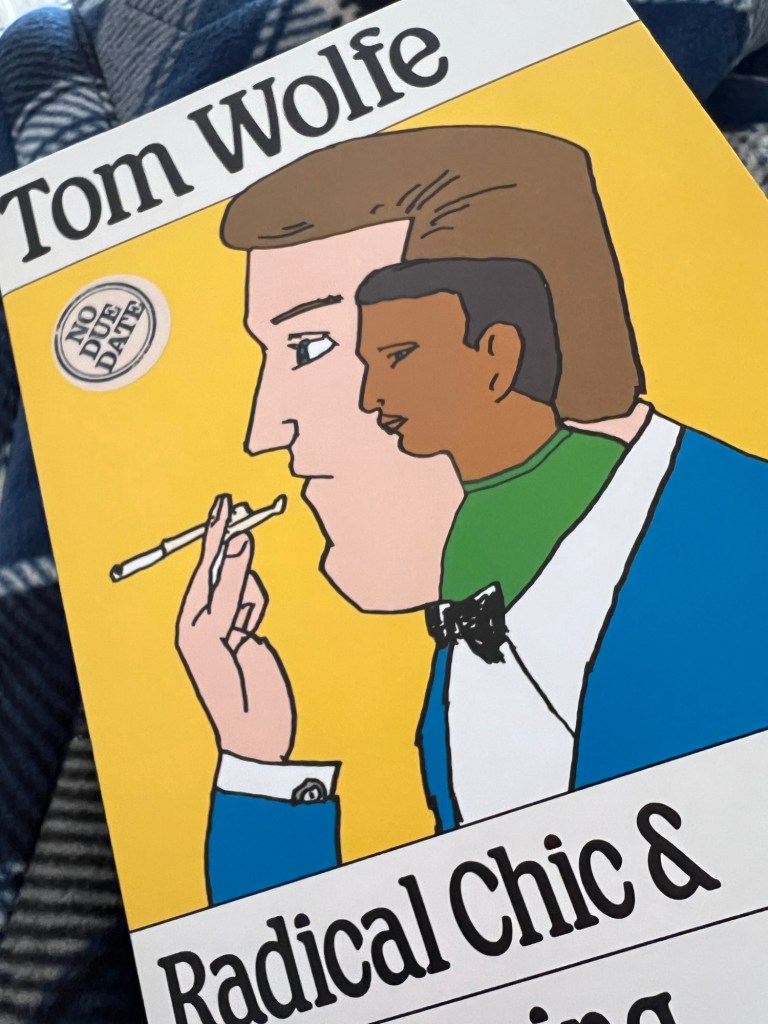
Who doesn’t like a wry metaphor or particularly apt simile? Tom Wolfe’s writing is rich in both. His short story Radical Chic depicts the wealthy of NY cooing over the edgy Marxist-Leninist black power organization.
For example, does that huge Black Panther there in the hallway, the one shaking hands with Felicia Bernstein herself, the one with the black leather coat and the dark glasses and the absolutely unbelievable Afro, Fuzzy-Wuzzy-scale, in fact—is he, a Black Panther, going on to pick up a Roquefort cheese morsel rolled in crushed nuts from off the tray, from a maid in uniform, and just pop it down the gullet without so much as missing a beat of Felicia’s perfect Mary Astor voice…
And this is all in one sentence. As a high schooler I would try out a few colorful comparisons just to have my paper returned marked up in red: too DRAMATIC! I guess you have to be famous to be creative.
There’s more to talk about in Radical Chic than a descriptive tableau. Perhaps we should take a cue from economist and blogger Tyler Cowen, who recently wrote about the Odyssey in economic terms. After all, the point of Radical Chic is a money transfer from the ultra-rich to a group with a cause, the Black Panthers.
In the Odyssey, the people involved are neatly tucked away on their islands. The groups are clearly delineated as a sea separates them from the others Homer meets on his journey. Fortunately, we have the clever and perceptive Tom Wolfe. He makes the reader see the affluent managing their servants in their townhomes in Manhattan. He corrals one group with descriptors and then another.
What the Bersteins will find out is that there are, in fact, many groups to consider. Many more than the radical chic who desperately needed something new and different in their lives. By the short story’s end, Wolfe lists many more economic players.
FOOLS, BOORS, PHILISTINES, BIRCHERS, B’NAI B’RITHEES, Defense Leaguers, Hadassah theater party piranhas, UJAvia-tors, concert-hall Irishmen, WASP ignorati, toads, newspaper readers-they were booing him, Leonard Bernstein, the egre-gio maestro… Boooooo.
As Leneord Berstein, a famous maestro, is booed while on stage, he learns that there were many more groups in play than the virtuous and the radicals, and this fact has led to him taking a private loss.
As we say here at Home Economic, context is important. Recently I heard the figure of twenty homes as a sweeping number with respect to an impact on a neighborhood. In order to evaluate an impact, it is necessary to know how many homes total constitute a typical neighborhood.
A standard city block with a sidewalk out front and an alley to the back generally has twelve to fourteen homes per city block. So if you were to think that your neighborhood was your block and two to the north, two to the east, two to the south, and then two to the west – you would have about 230 homes in total. In this case, twenty homes is about ten percent. If all these homes were in poor repair, for instance, this could be noticeable and have a negative effect on the outward appeal or from the street view.
Neighborhoods are quite a bit bigger than a cluster of two blocks to either side. Here’s a neighborhood map of Minneapolis, for example.
The USPS offers a useful tool for direct marketers which calculates the number of residential mail stops on mail carrier route (it’s called Every Door Direct Mail). We can use it here to help estimate the number of households by neighborhood. The first map is for the Armatage neighborhood. The number of homes comes in at 2620. Since the routes overlap into Fulton, let’s use a number of 2400. In this case twenty homes in the Armatage neighborhood makes up 0.83% of the total.
The Fowell neighborhood on the other side of town is know for having a larger share of corporate owned rental housing. Here, our USPS tool tells us that the neighborhood contains 2182 properties. Again rounding down is appropriate as the one route that runs on the west side of the cemetary is in the Victory neighborhood. Let’s use 2000 homes, in which case twenty porperties is 1% of the total.
It’s hard to see where one percent of a total number can have an effect on quality of life issues.
When a raw number gets tossed into a conversation as if it were a grenade ready to explode, always ask for context.





 Home Economics