Bertrand Russell talks about Mill and Marx

The history of words is curious. Nobody in Mill’s time, with the possible exception of Marx, could have guessed that the word “Communism” would come to denote the military, administrative, and judicial tyranny of an oligarchy, permitting to the workers only so much of the produce of their labor as might be necessary to keep them from violent revolt. Marx, whom we can now see to have been the most influential of Mill’s contemporaries, is, so far as I have been able to discover, not mentioned in any of Mill’s writings, and it is quite probable that Mill never heard of him. The Communist Manifesto was published in the same year as Mill’s Political Economy, but the men who represented culture did not know of it. I wonder what unknown person in the present day will prove, a hundred years hence, to have been the dominant figure of our time.

Bertrand Russell remembers Joseph Conrad

I have a slim book called Portraits from Memory and Other Essays, by Bertrand Russell. Here’s what the famous mathematician-philosopher recalls about the author of Heart of Darkness.

He spoke English with a very strong foreign accent, and nothing in his demeanor in any way suggested the sea. He was an aristocratic Polish gentleman to his finger tips. His feeling for the sea, and for England, was one of romantic love–love from a certain distance, sufficient to leave the romance untarnished. His love for the sea began at a very early age. When he told his parents that he wished for a career as a sailor, they urged him to go into the Austrian navy, but he wanted adventure and tropical seas and strange rivers surrounded by dark forests; and the Austrian navy offered him no scope for these desires. His family were horrified at his seeking a career in the English merchant marine, but his determination was inflexible.

The two became close friends. Each identified in the other a shared esprit.

In all this I found myself closely in agreement with him. At our very first meeting, we talked with continually increasing intimacy. We seemed to sink through layer after layer of what was superficial, till gradually both reached the central fire. It was an experience unlike any other that I have known. We looked into each other’s eyes, half appalled and half intoxicated to find ourselves together in such a region. The emotion was as intense as passionate love, and at the same time all-embracing. I came away bewildered, and hardly able to find my way among ordinary affairs.

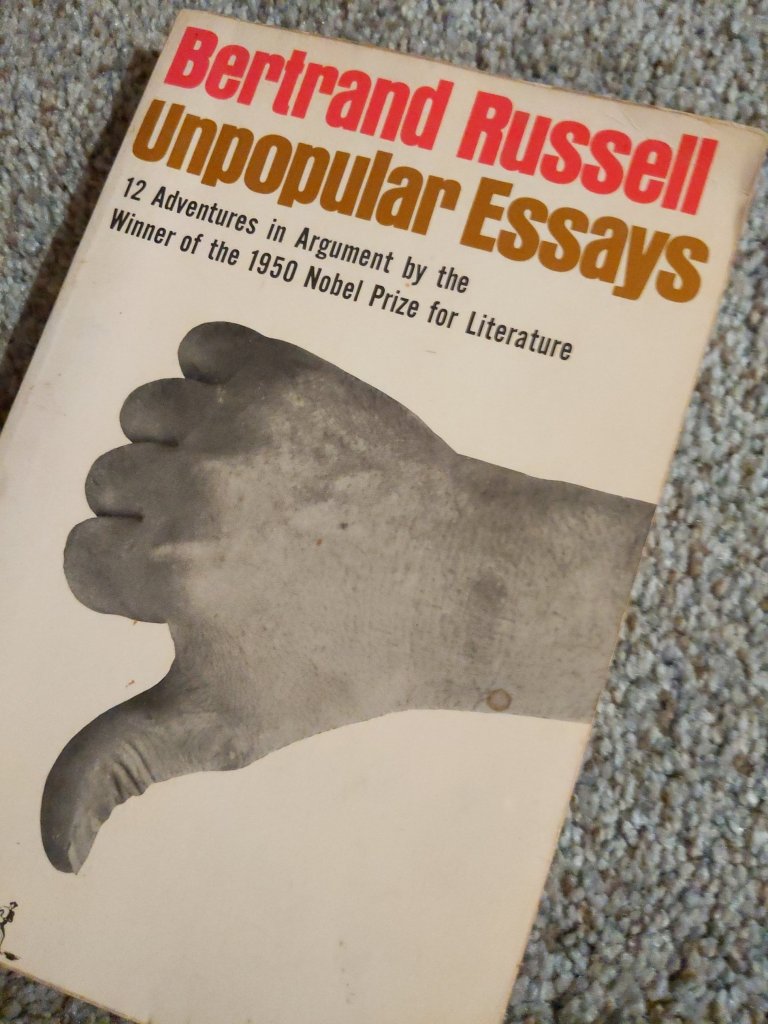
Words from Unpopular Essays

Philosophy has had from its earliest days two different objects which were believed to be closely interrelated. On the one hand, it aimed at a theoretical understanding of the structure of the world; on the other hand, it tried to discover and inculcate the best possible way of life. From Heraclitus to Hegel, or even to Marx, it consistently kept both ends in view; it was neither purely theoretical nor purely practical, but sought a theory of the universe upon which to base a practical ethic.

Bertrand Russell