Will signs work?

I say no.

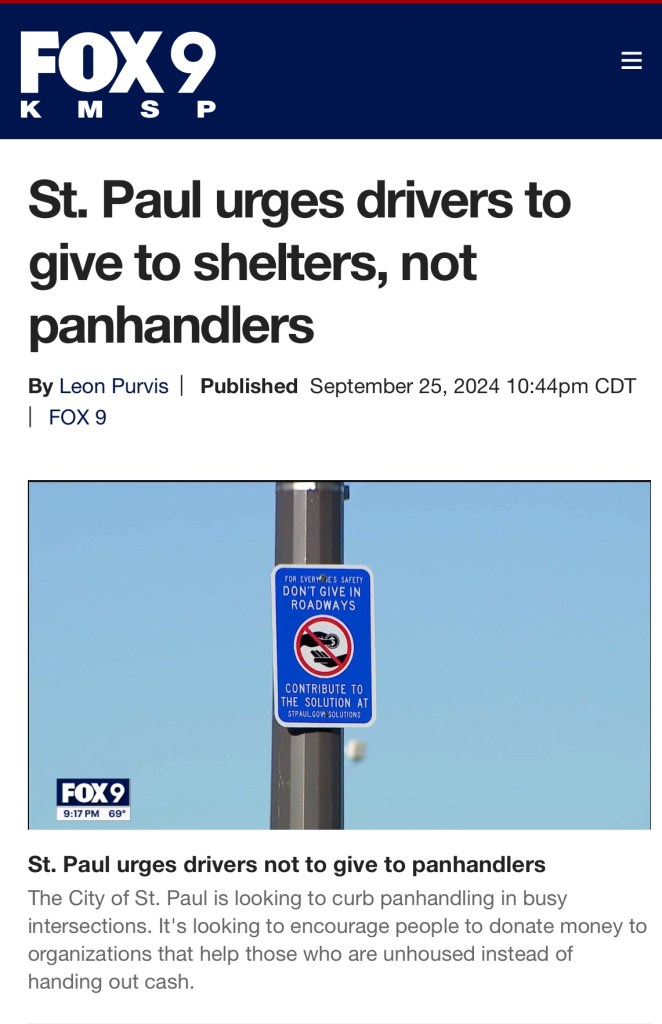
The City of St. Paul is looking to curb panhandling in busy intersections. It’s looking to encourage people to donate money to organizations that help those who are unhoused instead of handing out cash. FOX 9

City leaders say they’re doing it for public safety reasons. It’s putting signs up at intersections to bring awareness to drivers on how to help those who are unhoused. 

This is so Minnesotan. If we simply ask nicely, the good people of St. Paul will listen and do as we say! Let’s ignore incentives and inclinations.
There are two groups and two forces at work. The well enough to do in their cars are compelled at the sight of the need to fulfill an urge to act. Their instincts are crying to lend a helping hand. This is so easily accomplished by reaching into a wallet for a few dollars and rolling down a window. Searching for a reputable organization to direct funds to is tedious and not very rewarding. When you send in a check, you just get a thank you but no human touch.

Incentives for Group 1: Sign 0 Direct Give 1

The second group is the panhandlers. They have a need and are working to externalize cash from motorists’ desire for mutual aid. Although public policy types may rationalize that these folks really need this, and really need that, and it’s all because of X, does not eliminate the clear immediate need for cash. That’s their mission. The solution in the sign does not meet this need.

Incentives for Group 2: Sign 0 Direct Give 1

The sign idea does not work. If vouchers were given to motorists who want to reach out and touch someone to make a difference, and the panhandler could take said voucher to the organization for cash, among other things, then you would meet the incentives for both Groups 1 and 2. The organizations would also have a shot at ‘selling’ the panhandlers on their other services. If successful, the panhandlers would no longer need to hit the curbs with their stools and cardboard signs.

The business of Public Goods

My grandmother would tell a story of giving in their rural Iowa community. Word would get out after a Sunday service at Holmes Lutheran Church that a family was in need. A gathering of kids’ clothes or staple food supplies would be left in a neutral pickup area, maybe at the end of a driveway. Then the mother in need would later pick it up. Poverty was shameful, you see. Direct contact in the transference of aid would be a disrespectful slight on their condition.

The evolution of social welfare has come a long way since the happenings along the gravel roads squaring off sections of farmland. Provision of resources funnels through formal government channels instead of being left solely to the church aid societies of the 50s. Efforts to detach stigma from acceptance of aid are ongoing. The evolution of food stamps is a credit card with funds for the purchase. Free lunches are provided in all school buildings so there is no distinguishing between families that qualify for aid and those who don’t.

It’s hard to see how public humiliation in the face of unforeseen circumstances is profitable. However these control mechanisms were developed as a means of discouraging group members from taking more out of the communal pot of resources than needed. It was a social metering of loosely held assets. Back-up reserves are not attached to one specific individual in the group. They are intended to meet the shortfalls of the worse off.

Scolding looks are used in other ways to keep up shared appearances, When the neighbor grass is getting knee high they may feel the scorn of dogwalkers as they pass on the sidewalk. Pushing and nudging with looks, back turns, and low whispers are simply how it’s done in society when it’s thought necessary to get the word out about control of shared space.

There’s a two-fold reason these norms are swept away in the face of dire poverty. The unkindness is too harsh as the victims are too vulnerable. And furthermore who wants to discourage, in any way, a mother from taking food for their child? The desire for stigma-free acceptance of benefits for kids is simply a long-term win for the group. Healthy kids make for healthy adults.

There are those who, however, may come to an erroneous conclusion about the tapping of public benefits without those disdainful social guardrails. Some will pursue as many benefits as they can find available to them with no personal calculation of need. And others still take the pursuit of public benefits as a business model. They dreamt of being an entrepreneur, they say. This claim is being made in defiance of accusations of fraud.

When public goods and resources are formalized through government metering, then funny things happen. They no longer have the appearance of a common pool resource but rather they take on a more private form under the guise of a ‘program.’ Gone are the nuances of need-based use. Instead, they are peddled and appropriated in a coin-counting manner.

Perhaps an ingredients label is required. This is a one-hundred percent publically funded resource. It is fraudulent to transact outside its intended mission.