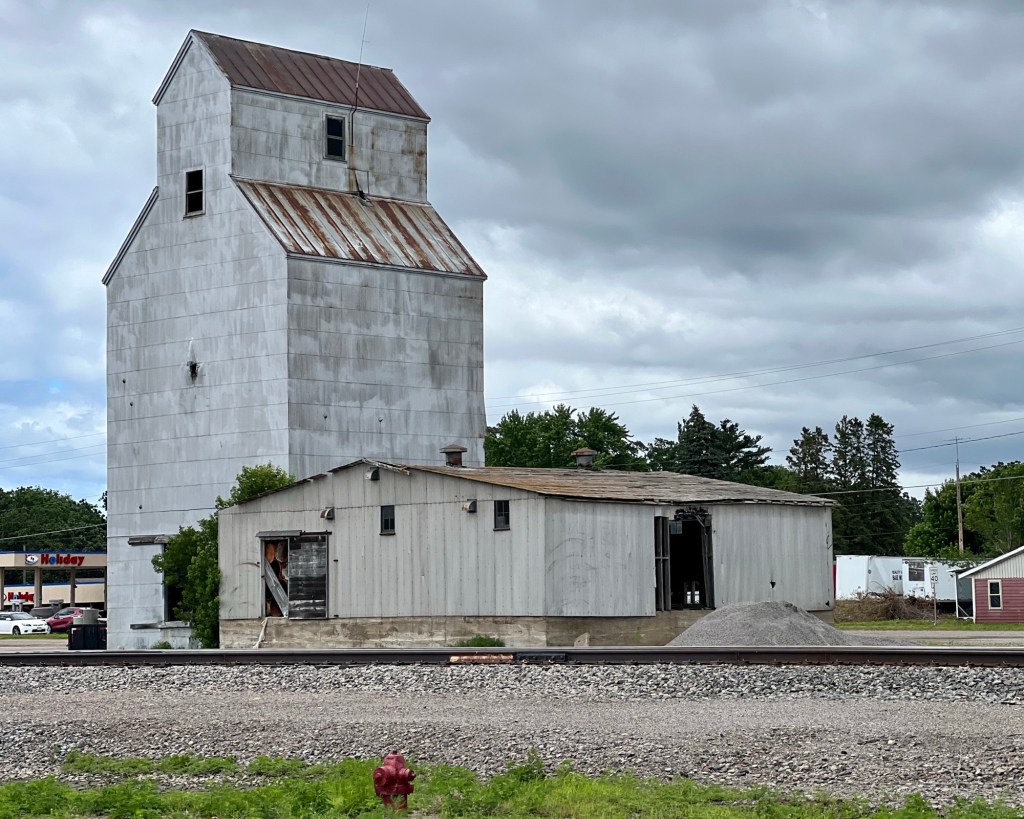
What a grain elevator could say

The grain elevator was the most ubiquitous commercial building in Minnesota’s small and medium towns during the mid to late 1800s.

In most towns in western Minnesota, grain elevators were the dominant feature of the skyline 1837 Treaty | Minnesota DNR. As railroads expanded westward in the 1870s-1880s, grain elevators sprang up along every railroad line to store wheat and other grains before shipping them to Minneapolis and beyond.

This makes perfect sense given Minnesota’s economy at the time. Wheat farming dominated the landscape, and Red Wing held the title as the world’s largest primary wheat market in 1873, exporting 1.8 million bushels valued at more than two million dollars United States v. Sioux Nation of Indians – Wikipedia. Every town with railroad access needed a grain elevator to collect, store, and load farmers’ harvests onto railcars.

Typically, small services would pop up alongside the tall wooden structures. Or an eating and drinking establishment. Sometimes a church was erected down the road a bit. And for decades, the railroad infrastructure supported a node of activity in remote rural areas.

A shift occurred once the interstate system was established in the 1950s. Rail is still most beneficial for long hauls, whereas trucks carry the grain for shorter distances, typically under one hundred miles. With fewer stops, the isolated wooden elevators fell into disrepair. Often they fell for the useful purpose of serving as a training exercise for local firefighters.

The purpose of this short vignette is to show how land uses are tied intimately with public infrastructure. And these types of projects are engaged over long time frames. A slow natural progression of the property from peak usefulness to decline can be led by aging owners, people who can view themselves in a steady state for another decade or more. The insight for the outside observer to understand where in the process a parcel finds itself. And then to implement policy in relation to the receptive impulses of that moment.

Ownership Issues – Water out West

Water is a slippery issue. You can pump water from the ground if you have your own well. It costs you the electric bill. As an owner of the lot, you have rights to the water swelling through the subterranean substrate.

The farmers who arrived first in the West have rights to the water in rivers through the first possession doctrine— a similar principle to land and mineral rights. Under this doctrine, historical patterns of water use give rise to de facto property rights. Specifically, whoever historically has diverted water and put it to beneficial use gains a legal right to continue diverting water for beneficial use in the future. Farmers diverted flows from rivers and streams through dams and irrigation ditch networks. Projects by the Bureau of Reclamation, part of the U.S.

Department of the Interior, augmented these systems and after 1926 would contract only with irrigation districts for water delivery. The fact that farmers have rights to and use vast quantities of water in an arid region is not a problem, in theory, if those water rights could then be traded to urban users who might value them more. But the history of water trading in the West offers a cautionary history about how difficult it can be, in practice, to facilitate true markets and arrange trades through property rights. (The West Needs Water Markets, but Achieving That is Tough, Peter Van Doren)

When you pay a water bill in an urban area to your local municipality, you are paying for the infrastructure to pipe the water to your home, as well as the water treatment process. Private property rights determine the type of access: well, municipal, irrigation ditches… The value of the water shows up as capital in the plot of land with access rights.

To obtain Owens Valley water for the aqueduct, the Los Angeles Water Board purchased over 800 farms and the water rights that came with them. Negotiations were difficult because of bilateral monopoly. The board was the only buyer and was under pressure to buy because Los Angeles was in a drought in the early 1920s. Large farmers formed pools to collude as sellers. Sellers wanted the surplus from the increased land values in Los Angeles arising from the water availability. The city’s board offered compensation based on agricultural revenue from the farms.

The LA people wanted to buy out agricultural land based on farm use. The farmers realized they were selling access to water. Thus they based their price on the value increase of the properties receiving their water rights in LA. This makes sense.

But then there can be no complaints when the agricultural land can no longer be farmed. The property’s use value transformed, and the transaction compensated the sellers at market value.

Future Farmers of America- Minnesota Edition

Years had passed without me giving the FFA a second thought. If someone had asked, I would’ve bet money on their demise years ago, during the era when everyone talked about the death of small-town rural America. If it hadn’t been for stopping at a rest stop on Sunday, the organization would still be out of my sight.

As it turns out the two bus loads of kids who were shoulder to shoulder in line for the sandwiches were headed to the FFA Minnesota State Convention at the UMN. Three days of events starting at a very early 7:30am. The dairy evaluations were at 7:45am.

This organization is not lacking for members eventhough it seems to be lacking media coverage.

Minnesota’s 95th State FFA Convention was held April 21-23 at 3M Arena at Mariucci and at the Minnesota State Fairgrounds.

Speakers, awards, competitions, workshops and sessions were some of the highlights for more than 6,000 FFA members from Minnesota attending the convention, celebrating the convention theme “Achieve – What It Takes.”

Here are some stats:

4,200 FFA members 7th-12th grade are pre-registered for the state convention.
15,000 FFA members in the state.
40,000 Minnesota students are enrolled in Agriculture, Food and Natural Resources (AFNR) classes.
218 FFA Chapters in Minnesota middle and high schools.
338 Agriculture, Food and Natural Resources teachers/FFA advisors in the state

This is from from a Grand Rapids outlet, WDO

Youth interest in rural communities is good news for the environment.