It might be my imagination, but I sense a subsurface tension in the teaching community around the issue of the extended Covid school closings. It lurks like other things you can’t quite detect: a high pitched dog whistle or the floor beneath your feet right before a quake. Or even more material things like the moisture on your brow and that earthy smell in the hour or so before thundershowers roll in.
As long as the virus is still taking lives, the topic is off the table. But soon everyone will be vaccinated. Soon the teachers will be taking account of where exactly their students are at in the curriculum. Some who normally enjoy the challenge of working with the most in need, may find their charges have have slid in arrears, past due even for assignments pre-Covid.
Without the structure of school, without the routine, without the expectation of someone waiting for them, recognizing them, without the the fun as well as the drudgery of the school environment, they simply stopped paying any attention to their education.
As an outsider looking in, it seems the teacher’s union towed a tough line. The virus put teachers’ lives at risk. The end. Apparently their work is not essential to the functioning of society. Decades of negotiating wages and benefits right down to each and every minute of their instructional day has made it easy to disregard any intent of the job and only see their work from a pecuniary point of view.
How the teachers who carry an old school sense of service to the community feel about this very privatized manner of handling their chosen profession is yet to be seen. Unions deserve credit for elevating teachers’ wages, and after all, spirit or no spirit, one has to pay the bills. Still–in years gone by, teaching was more of an employment of the heart, it involved a sense of duty, and was regarded as such.
So this cocooning of teachers away from the public while grocery workers and nurses became celebrated frontline workers, this buffering of their duties to educate seven, eight and nine year olds through Zoom screens can’t possibly fulfill the desire to be in good standing within the community. Some might feel the dignity of their work has been stolen out from under them.
Maybe when they were young pups trying to figure out their career choices, they absorbed the fact that teaching would pay less than other professions in business or law, but as a counter balance, they valued the sense of contributing to a greater cause. Teachers are trusted. Teachers are a source of advice. Teachers have the ability to play the role of a connector. At least for now.
For every minute of labor, the union has monetized their job. Perhaps the process has squeezed out any compensatory allocation to good will, to the noble cause. The power of the union is to talk in one voice. Then there is little hope of those within, who oppose its direction, being heard in any way.
This is all speculation on my part, of course! Classes are resuming, and by next fall all the soldiers will be marching to the old familiar cadence. Everything will be chalked up to the unprecedented and unanticipeted year of the plague. No matter. A little inkling persists. If you strip all the community value out of a labor force who is inspired by it, has worked for it, defends it; if you monetize every last moment of their day, at some point workers will revolt.
“Get it in writing!’ is the advise offered when entering into a contract. Too true. In particular when the parties have no relationship. If you want the law to back up your claim in an agreement, then it is a lot simpler if the terms are written out and both parties have signed in acknowledgement.
However, things aren’t always spelled out in a contract. A while back, in small claims court, I listened to a judge pull the rental agreement between a duplex owner and a tenant, one question at a time. It was clear he had some experience ferreting out these types of arrangements, to help settle who owed what to whom. He didn’t seem aghast that the plan at hand was verbal not written.
And before you judge, how many times have you clicked through the ‘I accept’ box without taking a moment to read what it is you are accepting? Written out yet neglected. We rush around our lives assuming the best.
Sometimes no one is clear what that ‘is’ is in particular. Technology has generated some truly stunning options, options unanticipated. When facebook provided that opportunity to reconnect with childhood friends around the world, it was intoxicating. Did I click right through the user disclosures agreeing to let their algorithms stalk my life and sell the information to advertisers? Yep. (or wait–were their any concerns of data privacy at the start?)
Written or not written. It’s not practical to put every moment of our lives into a written contract. Say you wanted to ride share with another family. You divvy up the chore, one takes the girls to girl scouts, the other to lacrosse practice. Stuff happens. Things get cancelled, rearranged, people have to be flexible.
Maybe one family does bare an larger burden. There’s no official settling of accounts, but for the relationship to sustain further commitments of work towards the children’s on-going experiences, more than likely there is some sort of make-up. Interaction continues. And this pattern can be seen in workplace groups, covering for each other or coordinating on projects. Work, exchange, work.
And when this pattern continues over a long period of time, people trust it. They rely on it. Home buyers, except for rare exceptions, diligently sign the stack of documents as indicated by the manicured finger of their closing agent. There’s no flinching at the part where the bank can foreclose for non-payment. Buyers rely on the knowledge that banks are competitive, consistent and regulated.
Consumers rely on a business climate. That many thorny issues have already been washed through mediation or courts by objectors who took their time to point out injustices. How can that be? It’s certainly not true everywhere in the world. The answer might be something like, “In the US we have institutions which allow consumers to trust the mortgage financing system.”
So in effect, institutions are the culmination of work which goes to enforce unwritten contracts on how to behave in (this case) the mortgage business. We have written contracts too, of course. But the trust in the system, the cart blanche, ‘I don’t need to have an attorney review this’ part is a trust based on social behavior and outcomes. Based on the knowledge that others have gone to bat and secured enforcement or change. That people were consistently able to work toward an outcome secured in the spirit of the transaction.
People often refer to institutions as a set of rules. I see institutions as the structure which allows work to occur and be captured in a non-fungible manner within a community. The greater the repetition, the greater the trust, the stronger the institution. We may even discover the value of unwritten contracts to far exceed the value of ones spelled out in ink on paper.
As you can see from the graph, the inventory of homes for sale in the Twin Cities had been fairly consistent until people emerged from the Covid lockdown and started buying last June. Now we are down 31.4% over last year. Buyers are buying but not enough sellers are bringing their homes to the market.
I speculate that some sellers are waiting until herd immunity as they are not comfortable interacting with the public. Some are being sold off market to Millennial children who are just now starting family formation. And some are being protected by stays which keep people in homes until after the crisis.
I remember posting my first public comment. I was nervous. I must have read through it a dozen times, and felt so exposed once I pressed enter–no edit back then. The article, Met Council: More focus on growing in place, was an opinion piece by local journalist and urban design consultant Steve Berg, writing here in MinnPost
Ten years have gone by, but the gist of what I was saying remains the same. People trade with an understanding of both a collective benefit, as well as one of self interest. At least that it what I am here to convince you of.
I loved commenting on Steve Berg’s articles because there was so much substance to target. Things have changed a bit since then. He was a classic anti-car guy, which has been toned down since Elon Musk came along. And you don’t hear people harping on sprawl as you once did. Nor market failure for that matter.
Pioneer Press North Dakota had adopted a law, proposed by the state’s Industrial Commission that oversees oil, gas and mineral removal, that gave energy companies broad power to continue injecting salt water, an unwanted byproduct of their drilling, and added rights to pump carbon dioxide deep underground and leave it there for eternity. This is becoming important as the cheapest method of “carbon sequestration,” which is deemed vital to reducing greenhouse gas emissions.
The law was very favorable to companies wanting to inject. It stiffed owners of land overlying the areas that might be filled. This created strong opposition, and a landowners association challenged it.
North Dakota had made an environmental claim on the subterranean space, but the landowners, who felt shafted by the fracking boom, said not so fast. They wanted in on the deal that seemed to pad everyone else’s pockets. So who owns the ‘pore space’ and who gets to benefit from it economically?
In mid-January, a state judge amped up the controversy in a broad decision favoring the landowners. He struck down the whole law as violating both the North Dakota and U.S. constitutions. He ruled it was a “taking” of private property as banned by our Fifth Amendment.
One can speculate on the line of thinking the legislators in North Dakota may have been following. Since everyone would benefit from the purging of by-products into the depths of the earth, than the assignment of the use of pore space to the energy companies is fulfilling a traditional public good.
As I’ve said here many times before, I do not believe in natural public goods. And this is just another example. Although the act of burying the carbon dioxide has a positive environmental outcome for the citizens of North Dakota, it is the land and the rights attached to the land that are under discussion. The land is privately owned by the landowners.
My view is that what is pubic and what is private comes about through tradition and legislation and cultural norms. In this case the courts decided. As the author says, there will be more to follow regarding “pore space.”
Legal scholars will write scholarly papers and economists will construct mathematical models. There are precedents in water and oil laws going back decades, but compressed gases that should stay there for millenia differ enough to open new controversy and give topics to hundreds of grad students who need thesis topics. And the outcomes will affect all of us.
Cost burdened is the catchphrase of the day in housing. Over the last couple of years it has popped up everywhere. Articles posted on all sorts of sites use the phrase without specifics on how they came up with all their charts and graphs. Smart Asset was good enough to describe its methodology.
Data and Methodology
SmartAsset used Census Bureau data to determine the most and least severely housing cost-burdened cities. This data, which we found for 126 cities, breaks down residents into the following brackets based on the percentage of the total household income they are spending on housing: less than 20%, 20% to 24.9%, 25% to 29.9%, 30% to 34.9%, 35% to 39.9%, 40% to 49.9% and 50%. The data also lists the total number of households.
We took the number of households in each city paying more than 50% of their income on housing and divided it by the total number of households in that city in order to come up with the percentage of households that are severely housing cost-burdened. We then ranked each city based on this percentage. We also calculated the percentage of households in each city paying between 30% and 50% of their income on housing, but this did not impact the ranking.
Data comes from the U.S. Census Bureau 2017 1-year American Community Survey
You can find more about the American Community Survey here. But I’m pretty sure the information about housing expenses is self-reported by the three and half million who receive the request.
As you do with ranking lists, I checked out my own community (childhood home of Senator Klobuchar no less) to see how we stacked up in the cost burdened arena. According to an extremely well regarded source of data and information to politicians and local officials, half of all residents of Plymouth, Minnesota are cost burdened. Seriously?
I’m not sure how this could be true for one of the more affluent parts of the western suburban Minneapolis-St. Paul metro area. So I checked another affluent area on the St. Paul side, Mendota Heights. Here it is reported that 75.4% of homeowners are cost burdened. Clearly there is an implementation problem with use of the data meant to determine those in need. More alarmingly, there it sits in bold bar graphs given to lawmakers and policy people.
But even if folks choose to pay thirty or even forty percent of their monthly cashflow for housing, who is the Census Bureau or the American Survey or HUD to say that it is too much? Consider these three scenarios.
I choose to live within blocks of my parents, even though their neighborhood is a little expensive. My parents are able to provide fulltime daycare for my toddler as well as before and after school care for my two elementary school children. Living in their neighborhood saves our family upwards of $2500/month.
I choose to live in the city which is noticeably more expensive than some first ring suburbs. This location allows me to take mass transit to work, shop and recreate. It’s easy and cheap and I don’t need a car. Between insurance, a loan payment and gas, I save $400-$500 a month.
I chose to live near my congregation despite the monthly rent being high in relation to my fixed retirement income. My apartment, however, is near my church and the fellowship is such a big part of my life. I am able to share transit to and from my doctor’s office which is close-by. Plus I feel safe.
(For some back of the napkin, points of reference, average rent in Plymouth is $1300. An income that is considered non-burdened (28%) is 4643$/mo. An individual is considered cost burdened (30%) at 4333/mo in income. A difference of $310. )
Evaluating housing based solely on monetary income and rent is grossly insufficient. Consumer housing choices are influenced -think back to your own choices- by all the services found in various neighborhoods. Each of these scenarios show how access to family help, transit infrastructure, and religious communities contribute people’s home economics.
Not only is the present methodology, (which is being projected in stereo as if on a national housing agenda of some sort) yielding reports declaring the poor rich as burdened, I argue the use of pecuniary measures, as the sole means of evaluating quality of housing, is starkly erroneous. If a ratio of rent to income is used (as it has been) as the primary driver in decision making, than less advantaged people will always be pushed into the least expensive rental markets. Surprising to no one is the market reality that these neighborhoods are lacking in support structures.
A handful of years ago a new term showed up in housing forums and real estate continuing ed classes. NOAH. The acronym stands for naturally occurring affordable housing. The Greater Minnesota Housing Fund explains:
The majority of affordable rental housing in the United States can be found in modest apartment buildings in every city and suburb.
These units are home to every stripe of renter and receive no federal or state subsidy at all. These Class B and Class C rental units comprise the bulk of affordable housing in the country today, but there is nothing to guarantee that they will stay that way.
Nationwide, this affordable rental housing is at risk. In prime real estate markets, this “naturally occurring affordable housing’ (NOAH) is often operated under poor management or in disrepair. Speculators are eager to snap up these developments, upgrade a few amenities, and convert these once-affordable homes to higher-market rents. This loss of affordability threatens the stability of individuals and families who are displaced, and even entire communities.
It was like a frosty burst of January air through an open front door. A much needed break from endless harping on ‘building’ more affordable housing. New construction is the most expensive form of housing and how it is in a community’s best interest pay top dollar for very few units is anxiety rising for any spendthrift.
It is equally refreshing to read that a real estate investor in Charlotte, Mark Ethridge, is building on the concept of NOAH. Here’s how he got started:
Ethridge had watched for years as properties like this were snatched up by big money investors who’d quickly renovate them, jack up the rents and then sell them off for a quick profit. With an estimated 120 people moving to the city every day and an economy on the rise, growth in Charlotte had put these kinds of apartment complexes in the sights of housing investors who saw them not as affordably priced homes for lower income residents but as undervalued assets.
Ethridge has attracted a bunch of like minded people to run up a $58 million fund for the purpose of providing housing at below market rates. The difference here is that his investors will receive annual returns on their investments, just at a reduced rate.
Bowles insists this is not philanthropy, and giving the fund a for-profit structure was a way to bring the discipline needed to ensure it would work for the long run. “We are capitalists,” he says. “We believe in capitalism. But if it’s going to survive, we have to make it work for more people. A lot more people.”
The city is still involved with help on the financing end of things and in return there is a twenty year deed restriction placed on the title of the property to ensure 80-100 percent of the units are rented to residents at the low end of the income scale.
Ethridge calls the effort “social impact capital,” and he says the Housing Impact Fund’s investors recognize that their investment can be both beneficial to society and profitable. “The nice thing about buying existing properties, unlike new construction, they cash flow the day you buy them,” Ethridge says. “So we will pay quarterly returns to our investors and we expect that cash flow to be relatively consistent.”
In a Bloomberg article yesterday, Laura Millan Lombrana encouraged governments attending the United Nations climate talks to push oil and gas companies to fix methane leaks. Due to new satellite technology, which helps identify the location of the seepage, there is an economic efficiency argument to such action.
Methane emissions need to fall 70% over the next decade, a decline equivalent to eliminating CO₂ emissions from all cars and trucks across Asia, according to the report. Fixing methane leaks would be cost-effective for energy companies because the captured methane can be sold as natural gas. The cost of repairs and maintenance needed to capture methane can often be paid for by the value of the additional gas brought to the market.
The new information (as to where the pipes are leaking) is one driver for action, but there is also the notion that the low emissions benchmark, set in the Covid year, offers up a new goal. This combination of information and technology coupled with motivation, made me think of Harvey Lieberman’s concept of “X”-Efficiency. He was a professor at Harvard and is best known for coining this concept. Here’s how he describes it in Allocative Efficiency vs. “X”-Efficiency.
Our primary concern is with the broader issue of allocative efficiency versus an initially undefined type of efficiency that we shall refer to as “X-efficiency.” The magnitude and nature of this type of efficiency is examined in Sections II and III. Although a major element of “X- efficiency” is motivation, it is not the only element, and hence the terms “motivation efficiency” or “incentive efficiency” have not been employed.
He identifies the possibility of meeting a higher efficiency with new motivations, usually in combination with other factors. In the Bloomberg article, the sense of urgency around climate change motivates fixing the methane leaks.
The level of unit cost depends in some measure on the degree of X-efficiency, which in turn depends on the degree of competitive pressure, as well as on other motivational factors. The responses to such pressures, whether in the nature of effort, search, the utilization of new information, is a significant part of the residual in economic growth.
It’s hard to know for sure, but it sure seems like Leibenstein’s “X”-Efficiency refers to the efficiency attained in the blending of the public and private spheres.
Economics studies the competitive and cooperative behavior of people in resolving conflicts of interest that arise because wants exceed what is available.
The EPA has designated January as National Radon Awareness Month. “Test. Fix. Save a life.” is their tag line.
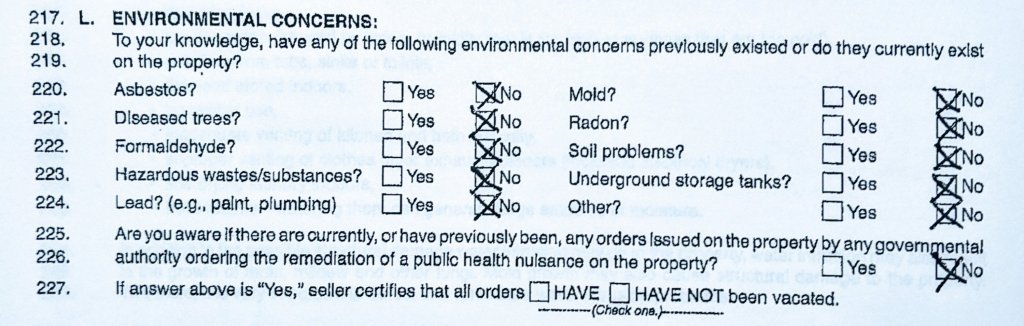
Those of us in the business of helping folks buy and sell homes, have been hearing about the health concerns emanating from radon seeping into homes for the past twenty years. In the first part of the 2000’s, health department officials encouraged buyers to test for radon at time of purchase. Radon was listed alongside a variety of other environmental concerns on the state of Minnesota mandatory seller’s disclosure.
Consumer response to radon did not match the government’s concern, and in 2014 the MN Radon Awareness Act went into effect. The variation in apprehension is best represented by the amount of space now dedicated to the topic in the seller’s disclosure. Lines 279-309 (2020 version) of the body of the disclosure speaks to radon alone–more lines than wells, septics, or any other topic. And two pages of information regarding the detection and harm of radon gas were tacked onto the end. Out of a twelve page disclosure virtually three pages, or one quarter of the document, is now devoted to radon (as opposed to foundations, or water penetration, or roofs).
The new disclosure established an industry standard which dictates the seller is obligated to mitigate a home which tests above the 4 cPi/L established by the EPA. It’s unclear if buyers request the install due to fear for their health, or because they don’t want to be the sucker-who-got-stuck-with-the-bill at a later date, when they go to sell.
Over the course of implementing tests and installations there have been some inconsistencies which have resulted in the need for a final arbitrator. For instance, a few years ago an inspector turned off the air exchange system that a seller had installed in his 1920’s home to enhance the heating and cooling functions. The EPA guidelines state that HVAC systems should be running as normal during the test. However, since this air exchanger was located in the attic (not in the basement) the inspector felt it was an extraneous appliance and turned it off.
The reading came in slightly over the benchmark of 4 cPi/L. As it had already been a contentious negotiation the seller refused any additional compensation. The buyer choose to use $1200 (compensation negotiated for a cracked clay chimney flu) on a radon mitigation system that would not be necessary had the exchanger been left running. They chose between fire safety and radon safety.
By early 2019 licensing of inspectors who perform radon testing was implemented to handle the inevitable variations in the use of the testing apparatus, including decisions regarding air exchangers. Since the MN Radon Awareness Act went into effect, a whole industry of inspectors (tests range from $180-$240) and mitigation installers (system installation ranging from $1000-$1800) as well as a bureaucracy to monitor and deal with complaints, has been established.
Background
The story the Minnesota Health Department has been stressing is that cancer is the leading cause of death in the state. But the leader is all cancers. Mortality rates for cancer vary within demographic groups, but generally, lung cancer makes up around 25% of cancer fatalities. Radon is called out as the second leading cause of lung cancer after cigarette smoking. What they don’t say is that radon is lumped in with second hand smoke and accounts for just 12% of the cases of lung cancer.
Feel free to chime in if I’m doing my math wrong, but a quarter of all cancer cases is around 2500 (lung). Then twelve percent of that number is 2500 x .12 = 300. In other words, death due to radon isn’t even on this top ten chart. It accounts 38% of the souls that commit suicide.
From the keys on my calculator, I have death from radon registering in at no more than 5 per 100,000. Below this grouping of accidental deaths which make up 6% of all deaths (from MN Department of Health):
Falls (2.7%): 21.1 per 100,000 population
Accidental poisoning: (1.6%) 12.8 per 100,000 population
Motor vehicle (1.0%): 8.1 per 100,000 population
The average Minnesotan is four times more likely to die from a fall, twice as likely to be accidentally poisoned and slightly more likely to die in a car crash. The claim that more than 40% of homes in Minnesota are contaminating people’s lungs with radon gas and killing them is not jiving with consumers’ personal experiences.
Nationwide Agenda from the EPA
One has to assume that the MN Health Department is following a directive for radon procedures from the EPA’s national agenda. However the EPA offers not one article newer than 2003 on its website to validate research tying lung cancer to levels of radon in homes.
A paper from Korea, which looks at the topic using measures of radon in homes, was published in March of 2016 and is the most recent academic paper I could find. It too references almost exclusively research papers written prior to 2000. Ji Young Yoon et all (Department of Humanities and Social Medicine, Ajou University School of Medicine, Suwon, Korea) wrote “Indoor radon exposure and lung cancer: a review of ecological studies” which was published in The Annals of Occupation and Environmental Medicine. There had been no studies to date in their country. They found:
For Korea, we observed tremendous differences in indoor radon concentrations according to region and year of study, even within the same region. In correlation analysis, lung cancer incidence was not found to be higher in areas with high indoor radon concentrations in Korea.
Scanning the bio’s of the faculty at the College of Design at the UMN, not one cites an interest or expertise in radon. There seems to be a lack of interest in funding or pursuing this topic.
How can we be following guidance that doesn’t appear to have been updated or even reviewed in the last ten years?
That was then this is now
Furthermore there has been a dramatic decrease in lung cancer’s claim on lives.
The death rate from cancer in the US declined by 29% from 1991 to 2017, including a 2.2% drop from 2016 to 2017, the largest single-year drop ever recorded, according to annual statistics reporting from the American Cancer Society. The decline in deaths from lung cancer drove the record drop. Deaths fell from about 3% per year from 2008 – 2013 to 5% from 2013 – 2017 in men and from 2% to almost 4% in women. However, lung cancer is still the leading cause of cancer death.
The American Cancer Society estimates deaths from all lung cancer in MN in 2021 will come in at 1950. Twelve percent of this is 234.
Time has changed the circumstances but there has been no release, or at least, re-evaluation, of the protocol. It’s like everyone moved-on and no one told the bureaucrats. So they keep RADON at the top of their checklist of ‘to-do’s. Meanwhile a whole industry of inspectors, installers and licensing and compliance people are settling into a new market.
It’s that mindset that if, ‘We can save one life!’ Then it is all justified. Yet–if 2020 has taught any lessons it is, that even in lives, there are trade-offs.
Costs
In 2019 closed home sales in the 16 county greater metro area (Minneapolis Area Association of Realtors) came to just shy of 60,000 transactions. Take out new construction (10%) and townhomes (25%), and take out a few for opting out of radon testing assuming 36,000 test were performed. A radon test performed by a now licensed inspector averages $200. The (conservative) amount spent on radon testing in 2019 totals $7,200,000.
The MN Department of Health estimates that 40% of homes in MN will test over the benchmark set by the EPA as hazardous to one’s health, or 4 pCi/L. That would lead us to expect that 40% of the homes tested high and negotiated the installation of a radon mitigation system into their purchase. At an approximate average cost of $1200, that comes to a total expenditure for the state of MN to (36000 sales x .4 x $1200) $17,280,000.
Based on these numbers, Minnesotans spent nearly $24,480,000 on mitigating radon in 2019. The tag line from the ‘EPA Test. Fix. Save a life’ promotes an image of each install resulting in fewer deaths to cancer. But is that true?
The amount of money our metro community spent on radon is a flash in the pan compared to a state budget or even a (metro) county budget. But $24,480,000 for community associational groups, who are on the ground interfacing with those struggling with mental health and substance abuse, it is a pot of gold. And that’s where the money should be going. When a 70+ year old passes, it folds into the course of life. The impact of a father OD’ing, leaving young children behind, or the death if a youth, high on the latest street drug, will galvanize community effects that reverberate, even to the point of burning down a mile stretch of buildings.
Wouldn’t our communities be better off by spending that $24,480,000 on mental health to deter suicide? Wouldn’t this, for instance, help with community policing? I say yes.
Motivations and Spheres
The difficulty, of course, is that we can’t transfer the $24 mil from the radon pocket to the mental health pocket. Government used their ability to pressure a commercial endeavor to set up the radon industry. In fact, with the death rate for lung cancer dropping, it almost feels like the health officials are spurred onto be more aggressive. “We’re doing so well making widgets, lets make more!”
Unfortunately this is a business mindset, for work in the private sphere, one that seeks to expand and grow. The public good mindset is quite the opposite. Since the work in the public sphere is often performed to prevent something from happening–as in this case, to prevent lung cancer. Once that is accomplished, activities should cease, and resources reallocated to other demands of the public that now climb up to a higher priority.
In the meantime, the industry standard for radon testing, at time of a house purchase, has created paying jobs for inspectors and bureaucrats. Quite naturally, their motivation will be to support this new structure from a private point of view. It is not part of their employment to evaluate whether this the best use of societal funds. The inspectors and installers and continuing ed teachers and state licensures and public health workers will support the process because it pays the bills that support their families.
What happened to the feedback loop? Where in the system should there be a check to see if programs are on the right track? Feedback has been stifled because to criticize the noble cause of saving life has not tolerated.
What I am and what I’m not saying
I am not saying I have the expertise to validate or deny the tie of radon in homes to lung cancer.
I am pointing out that public health officials have struggled to get this issue to take traction in the public mind. I am saying that no research in the last fifteen years has validated our present path to safety (and one study has countered it). I am saying that an industry, in the private sphere, has sprung from these government actions, draining over $24,480,000/year from community funds for this issue. I am saying death rates from lung cancer have plummeted in the last ten years. I am saying there is no feedback loop to public officials to demand a review. I am saying it is no longer good enough to make one agenda and then push it through for a decade without any consideration that time alters all things.
For a generation there has been the activist approach in government. Select a cause; implement it nationwide; get the talking points out to all the communication outlets so it is heard in stereo; then never relent. I am saying that this is no longer good enough.
While the government will need to employ short-term measures to avoid a wave of displaced households, one major step toward resolving the underlying problems in the housing market would be repealing an obscure 22-year-old addition to the Housing Act of 1937, the Faircloth Amendment. Passed in an era when the reputation of housing projects was at a low, the amendment prohibits any net increase in public-housing units.
This afternoon, as a lingering glow alights the World Trade Center and the lights go on at the Empire State Building, as the glimmers extinguish off the Hudson River, and the sun’s rays slide down New Jersey, Pennsylvania, Ohio, across the prairies, and silhouette the mountains of the West until finally slipping off the coast of California, Oregon and Washington, as the rays sink past Hawaii and into the Pacific, we say goodbye to 2020 with a wave. And a wish that we could give it a good kick in the petuti.
But this year allowed me to start this blog and I am very thankful for that. Readers have shown up in the hundreds, well over my expectations. I have relished every like and comment. Thanks so much for visiting.
The most popular article hands down was Is it so simple? A response to Nathaniel Rachman’s article in Persuasion allowed me to unabashedly promote the view that drives me to write this blog. These last three months have been devoted to laying some ground rules to how things work. There’s really no point to continue, if folks don’t see the definitions clearly of the economic nature of public and private transactions.
Since this is an economic philosophy I need to get around to tying it to material values, and I will get to such an accounting in due course. I could bring in the numbers, and show how they are assigned to forms of capital. But should people not accept the actors and the types of activity they do, all will be explained away, talked over. There will be references to cloaking and embedding and behavior.
For people to see the hard cash, they will have to see that private individuals employ time and resources to public endeavors everyday throughout; that governments are riddled with private transactions everyday throughout; that businesses develop goodwill on their balance sheets and accommodate labor demands everyday throughout; that associations are motivated by private ambitions while supporting the group’s goals everyday throughout. Until there is an acknowledgment of this type of dual structure–there is no point to assigning slices of material wealth to each and every activity.
Economics is not just represented with dollars. There are two natures to transactions. The value does show up in capital and dollars, most obviously when being externalized or internalize. Although-that moment is but a snapshot in time, a frozen price point, that could be simultaneously the result of the in-hand trade as well as the tapped capacity accumulated over generations. Hence the necessity to understand time.
For a generation, those who control the public purse have developed a party line, with nationwide control of talking points. They’ve developed an activist type of one issue dominance, with the devastating inability to see subtle trade-offs. They’ve basically obliterated the concept of varying degrees of importance. Covid has made this glaringly obvious.
So happily ring in the New Year! And ring out the old ways, while keeping an open mind to the new.
One of the benefits of raising a child is that you get to follow them through their interests and endeavors. My college sophomore was required to tackle two novels for his class on colonialism: The Poor Man’s Son and God’s Bits of Wood. Feraoun is the product of French Algeria and Ousame is from Senegal, part of Afrique Occidental Francaise (AOF) until 1958. Both tell stories of the struggles of their countrymen and women during the era of New Imperialism.
Unlike the conversation of today, both authors describe many more groups than the simple division of colonial power and the colonized, of oppressor and oppressed, or of those who take what is not theirs and those who are left without. How exactly the goods, services and resources are shared and divided between all the players is a preoccupation for both men.
Details such as, 180 francs– the amount of Feraoun’s scholarship to Ecole Primere Superieure, and 100 francs–the amount he turns around and sends back to his family in Kabylia. Then there is 25 francs and a container of barley–the amount that shows his family’s extreme financial distress. And 600 francs–the amount the headmaster hands over to allow him to continue his education.
Both authors detail workplace struggles. Feraoun’s father leaves for a time to be a laborer in Paris. When a workplace accident lands him in the hospital he is able, after two attempts, to secure a settlement of $3000 francs along with a quarterly stipend. Ousame describes the 1947 railroad worker strike with specifics on pensions and wage scales and family benefits.
There is a counting amongst the women as well in the home life of the railroad workers. There is the rice that the local grocer is forbidden to sell them, and a fight with the french soldiers over a leg of mutton. Feraoun finds his financial obligations to his northern Algerian family growing as his sisters’ husbands leave them for greener pastures. He counts thirteen dependents on his teacher’s salary.
There are many groupings in these stories; there are the workers, and the women, and the missionary, and the soldiers, and the french educators, and the French who show up to help with the strike, and the elders who feel disregarded–all pulling in many different directions for people’s time, talent, and assets.
It’s as if these authors are trying to sort through two spheres of economic activity, particularly set in contrast by private affairs and public affairs, by looking after the individual and being obliged to the family, as well as by outsiders and insiders. And the good and the bad make an appearance in every cluster.
Without a doubt, the richness of these detailed accounts of choices is far more interesting than the conversations of today.
The November 2020 tally of Realtor members of the National Association of Realtors totaled 1,460,397, making it the largest trade association in the U.S. There are just shy of 21,500 Realtors in Minnesota alone. The group is nonpartisan with a stated “mission … to empower REALTORS® as they preserve, protect and advance the right to real property for all.”
Maintaining property rights, so that their clients can buy and sell homes and investments, is an unwavering shared value amongst this group. Not only because it facilitates their clients’ and in turn their own private interests, but also because stagnant unproductive real estate becomes a drain on public interests in the form of crime, blight, and inefficient use of public infrastructure.
The good and the bad of it is that once you build an open and reliable system, everyone wants to use it–including the criminals.
Globally, real estate is one of the “laundromats” of choice for criminals seeking to legitimize their ill-gotten funds. Using shell companies and other shady venues, they annually funnel more than $1.6 trillion into real estate investments around the world. Despite federal efforts to crack down on the illegal transactions in the United States, money launderers continue paying top-dollar for purchases, driving up real estate prices in many cities.
NAR and other housing groups are urging Congress to stem the tide of dirty money by passing effective anti-money-laundering legislation. The organization is also launching an education campaign to help Realtors® identify the risks to their businesses and use best practices to protect themselves against liability.
More dollars chasing real estate means higher prices. Since a pricing system is dynamic and interdependent throughout an entire network, it means higher prices across the market, not just in apartment buildings or the venue of choice for foreign or domestic racketeers. So we could say that money launders are externalizing unaffordability to lower income homeowners, while internalizing the benefits of our property rights institution–including the work done by NAR and its members.
Wouldn’t it be interesting to know the tranche of the value that illegal activity adds to the price of a home, apartment or investment property? Even if it were only an estimate. Across a metropolitan area this maybe a small amount say half a percent, or around $1500 on the Twin Cities’ median priced home. Barely perceptible with all the other costs and expenses involved in a home.
But if the criminals did their business primarily in one neighborhood, (a neighborhood where people don’t have time to wonder why a property is left vacant, nor know where to file a complaint for snow covered sidewalks) their stake could have an outsized impact. It is in these locations that a large number of REIT’s and creatively named groups tend to appear, especially since the recession of 2009. If a large sell-off of their position swung pricing, say ten percent, it would have a destabilizing effect, especially if that neighborhood was already experiencing a variety of negative externalities.
Note the groups. There is the overall housing group of buyers and sellers (personal or investors) who are buying real estate to be used as places to live. The pricing system is a reflection of the value property commands as places of residence. The criminals are not participating in that market. They bring money into the market because it is reliable environment to launder their funds. While the criminals internalize this as profits, first time buyers in the large group can no longer afford to buy a home.
The presence of washermen (and women) in the marketplace also necessitates an increase in the stream of funding used to subsidize those of the larger group who are unable to provide for their own housing. It would be useful to know some of these numbers. Knowing the financial drain of the money launderers on our real estate market tells us how much the Justice Department can spend to pursue and capture these ne’re-do-wells. This is the housing justice we need to see happen.
In a recent paper, Balancing Purse and Peace:Tax Collection, Public Goods and Protests, Benjamin Krause from UC Berkley evaluates state capacity in Haiti. From the abstract:
Strengthening state capacity in low income countries requires raising tax revenue while maintaining political stability. The risk of inciting political unrest when attempting to increase taxes may trap governments in a low-tax equilibrium, but public goods provision may improve both tax compliance and political stability.
The author predictions are very intuitive: 1. decreasing pubic goods (in this case garbage collection) and fines decreases tax collection. 2. increasing public goods increases tax collection. What is interesting to me are the variables he chooses as benchmarks. The research measures the public willingness to pay taxes while tracking their voice as expressed in graffiti and the amount of time some members may spend on barricade building.
… I introduce two novel metrics for independently measuring political unrest. First, to measure political speech, I conduct a census of and geo-tag the graffiti across the city. I then use the presence, prevalence, and tone of political graffiti specifically as outcomes of interest. Second, to measure the most violent or destructive political unrest, I track the construction of barricades in neighborhoods which are built, and often lit on fire, as a form of protest in this setting. Tracking both where these are constructed and which areas are affected provide additional outcomes of interest. As a result, I am able to provide novel experimental evidence of the effects of both tax collection and public goods on political unrest – and on violent or destructive unrest in particular.
In my model I propose that in the public sphere, goods are provided when the voice of the group expresses a need and people are willing to do work on behalf of the objective.
In this paper the author measures voice by tracking graffiti. Lack of graffiti speaks to an endorsement of the state or a sign of favorable response to provision of garbage collection. And he measures work as the number of hours spent building barricades to protest against the state. Where lack of work is an endorsement of the state.
Exciting to see something similar appearing in an academic paper.
The word systemic keeps getting worked into the conversation these days. Like when kale was in fashion. Some healthy new food that all of a sudden is made part of every dish but you’re not really sure what you think about it. Systemic–it’s put out there in a more or less free standing sort of way without any follow-up examples or stories to prop-up exactly what the speaker means by it. What we are dished up is a description of a (negative) social outcome, one that occurred due to systemic issues.
Dictionary.com offers this: [səˈstemik] ADJECTIVE. 1. relating to a system, especially as opposed to a particular part. It seems we need to understand more about systems. A system is not the sum of its parts. Here is what Lebanese born author Nassim Taleb offers from his book Skin in the Game:
The main idea behind complex systems is that the ensemble behaves in way not predicted by the components. The interactions matter more than the nature of the units. Studying individual ants will never (one can safely say never for most such situations), never give us an idea on how the ant colony operates. For that, one needs to understand an ant colony as an ant colony, no less, no more, not a collection of ants. This is called an “emergent” property of the whole, by which parts and whole differ because what matters is the interactions between such parts.
So this Thing, that is socially detrimental, happens across a system. But what exactly? What happens that lies beyond the responsibility of one individual, and that echoes within a larger group of activity, that culminates into whatever it is being voiced as systemic? The gist is the Thing is a series of inter-related activities erupting into the highly objectional scenario at hand.
But why settle for gists and innuendo? Why not name this Thing? Why not fully flush out what it is that stair steps its way through households and into communities, through vendors and corporations, through bureaucracies and governments?
At the end of 2001, it was revealed that Enron’s reported financial condition was sustained by an institutionalized, systemic and creatively planned accounting fraud, known since as the Enron scandal. Enron has since become a well-known example of willful corporate fraud and corruption. The scandal also brought into question the accounting practices and activities of many corporations in the United States and was a factor in the enactment of the Sarbanes–Oxley Act of 2002. The scandal also affected the greater business world by causing the dissolution of the Arthur Andersen accounting firm, which had been Enron’s main auditor for years.[2]
There’s that word systemic again. At this (formally) worldwide energy company, accountants at all levels could have called out questionable practices but did not. Through failure to act the organization was complicit at all levels of covering up fraudulent accounting practices.
A contrarian might say, is that really fair? The employee’s contract is to fulfill their job description for a bi-weekly check. Today, in the bright of day, the deceit is clear. But in the rush of the workday was it muddled? When did the private contract between employer and employee take on a public obligation? If an employee calls out their supervisor, the writing is on the wall and the pink slip is in their in-box.
The systemic promoters are talking about failure within an entire organization. They’re saying that a weighting of choices throughout an energy company, or a government agency, or a group of neighbors, have social implications. That the cascading of choices of each ant in the system can allow for a horrific result. That each actor has a varying degree of control, of an ability to say no, of the choice to turn on the group and change its course.
So let’s name that little portion of something that could be done to stop a social ill, let’s call it work. The employee enters into a private contract for employment but carries a public obligation to disrupt actions which are contrary to established social compacts. The portion of obligation is tied to the level of ability to have an impact (you can’t really do much as a first year junior accountant). This is also work–it is work in the pubic sphere.
These systemic issues not only occur within private work life, but also the time we devote to our families and communities. When insufficient attention is paid to the elderly, we hear of abuses in nursing homes. When insufficient resources are paid to depression, there are suicides. These too are due to a piece-by-piece failure within the entirety to respond. These too are systemic.
The Thing is work, or housework if you prefer. Not the type of inflammatory action that the cancel culture takes to achieve their thoughts on their social need du jour. The work of stopping over and taking your depression prone niece out for a daily bout of fresh air; the work of maintaining the ballfields for the little leaguers; the work of staying late one day to scrutinize the accounting that seemed awry but you had to really take a few minutes to double check for inconsistencies. It’s the small bits of work by hundreds (of millions) of employees and community members to maintain a certain standard of established norms.
It’s fine to start the conversation with, “All these xyz bad things happened and it’s Systemic!” But we can’t exactly tackle the correcting measures without understanding where and how in the system work can be done to achieve a better future.
Parochial schools are doing well, from what I hear, in the battle to attract and maintain a student body. They opened on time in September with increased enrollment, and have stayed open through this Thanksgiving holiday. There will be a break in in-person learning now (like all other schools and universities in the area) until January. My sources report no sizeable outbreaks or health concerns for either the learners or learned.
The 91 Catholic schools in Minnesota compose the 4th largest district in the state. This unexpected swelling in enrollment is a benefit to their bottom line. As they do not receive the per pupil funding which finances the public schools, they are on their own to market within their faith community as well as to those who value smaller class sizes. In some cases, sports families are attracted to an increased probability that their athlete will make the varsity team.
The use of direct mailings to reach families throughout the area seems like a good fit. However, when a large public school district, where attendance is dictated by place of residence, pummels direct mail right over school boundary lines, it feels objectional. Why is that? Both the schools are in the business of delivering education, both require funds to operate. Attracting students is the same as attracting customers–no?
Customers use private funds to purchase a good or service. The parochial schools are offering a service, one that complies with the standards set by the state, but has been customized to the requirements of a specific community. The funding that follows a child to the public school district they attend is not private, it is taken from a pool of funds which is collected under mandate to educate all Minnesota kids.
Plus– it isn’t just the funding allocated per child that is lost when a family sends their offspring out of their district. Since busing is only offered within the school boundaries, it is a given that one parent is available to drive them to and from school—or will once the whole virus thing wraps up. By self-selection these parents often donate their time to school activities, fund raisers, and all those extras efforts that make an educational community stronger.
So when a school district pumps a bunch of dollars into a direct mail piece with messaging along the lines of, ‘Hey, we’re better, come on over,’ they are drawing students as well as high-social-capacity families to their district. Which means they are draining adjacent districts in an equal amount. On net, the dollars spent on this type of private business marketing is not fulfilling the state mandate to educate all students. But rather is congregating the haves and leaving behind the have-less’s.
The parochial schools are working in a private sphere even though they are fulfilling a public obligation. So it is fitting for them to use private strategies. Public schools are working in the public sphere so using private methods sets up externalities.
My son is an engineering student, but for his liberal arts requirement he is taking a course on Imperialism. The course work tells the tale of western European economies growing so that they ventured past their countries boundaries to extract resources from Africa and Indo China and the Caribbean. The model describes a dominant group taking hold of a subservient group to help themselves to resources for commercial gains. Extraction isn’t just for the history books. Consider this fictitious story.
Let’s say there is a fairly large association for a trade group. It has a sizable staff and a fair number of members volunteers. There is also a multi-decade volunteer–let’s call him/her Jo Johnson– who through time and understanding has proven agile in eliminating dissenting voices and bullying staff. There are also dues, and committees, and boards, and political action.
The associational group has clout in a community due to its size and ability to organize. It also has some resources to pledge toward those seeking local office. Jo Johnson’s influence at the association serves to direct funds to candidates who, in turn, respond with business referrals. This action of using a group resource and trading for a private commercial gain describes a process of internalizing a public asset into a private, fungible transaction.
Now some may say–this shouldn’t be so! There are ethics to think about.
But– this judgement, this evaluation of the trades in play, is best evaluated by members of the group–not outsiders. Some members maybe thrilled that Jo Johnson is able to devote countless hours wage-free to the association, and thus, any extracting done is small compensation. The members of the group may feel the clout of the group is maximized in this very fashion, giving each member the best possible slice of the overall pie.
It is really all about transparency. If members knowingly make the decision to defer to Jo, then all is right in the world. If decisions have been made for them because Jo Johnson has become so skilled at shaking loose the opposition by throwing up all sorts of meeting delays and rescheduling (it is a volunteer activity after all), and has the power to develop allegiances by promising titles like a board position (a dusty old king of sorts selling titles), then the peasants should revolt.
The process of extracting value from a group and in doing so moving a resource from a public sphere to a private transaction occurs all the time, in many different scenarios. It is a trade. Whether a trade is in equilibrium requires, not moral judgement, but transparency and an ability to evaluate the options at hand.
Given this is my 55th post I’d like recap the home-economics model. As explained on the About page, this site addresses the mechanics of value creation in the pursuit of pubic goods. In order to show these features, I must persuade you to shrug off a few established notions. The first is that the nature of goods is not public, nor club, common, or private (the purpose of the What is Public-What is Private posts). All goods can be employed in either the public or the private sphere. The second is that there is no such thing as market failure.
To start at the beginning, all of economic life is restricted by the resources this crusty old orb offers us along with what we can make of them with our time and talents. Limited resources applies both to goods employed in a private environment as well as those contributed toward community needs. Within these confines there are two types of activity creating a public sphere and a private sphere. One looks inward, behaving with a public (non-exclusionary) nature and the other activity looks beyond the group behaving in predatory fashion. This private sphere is well studied.
Let’s work backwards on some posts. Yesterday’s topic–Money and Safety— centered around the city’s approval process to fund more police force hours. Consider the groups. The defunders would argue that city money for police has resulted in providing safety for the racial majority (Gr 1) of the citizens (Gr 3) yet is failing to do the same for the minority groups (Gr 2). In light of this objection these city council members refuse to fund the police.
As an aside, this claim does not hold true. For the past five months the political climate in the city has severely limited the police’s capacity to maintain peace. The result has been a tragic loss of life primarily in Gr 2. This a new set of data contained in Gr 3 shows that it is group Gr2 which reaps greater (despite severe flaws) benefits than Gr 1. In addition to loss of life, Gr 2 has also disproportionately experienced a loss to businesses, where it is estimated 200 businesses burned or were damaged during the riots. The businesses suffered an externality from (lack of) services from the public sphere.
Consider the post A table set for adversaries. The outdoors women and men (Gr 1) are often at odds with urban arts people (Gr 2) over issues like gun control which increases the cost to own firearms without a clear benefit in reduction in crime, and funding for cultural events which requires subsidies to be viable, and outstate regulation of the environment which cuts jobs. Although Gr 1 and Gr 2 are often competing for resources they hold together in conjunction with all Minnesotans (Gr 3), by showing where Gr 1 and Gr 2 had a common interest, a funding stream was extracted from two very different associational groups.
Fire Station 2 speaks to the structure of firefighters (Gr 1) who devote their time and expertise at a reduced rate to protect the lives of property of their community (Gr 2). They get paid a below average hourly rate, which is a private transaction. The firefighters’ extra wage potential is community (Gr 2) work. Their services are made available to everyone (Gr 2) which makes this a public service.
Having established the need to look for groups, and identify whether the groups are engaging public or private economic activity, I’ll be posting more on externalities and internalizing. Both of these terms describe the appearance of positive or negative effects which show up in one sphere from a transaction in the other (Ex. private corporation pollutes the water causing a negative expense to a public good owned by the surrounding community). Then we can get to the fall of market failure.
I’ve been working my way through a list which claims that economic goods fall into four categories– private, club, common and purely public– in order to debunk a misconception on how we sort economic activity. Web oriented services such as Wikipedia, NetFlix and website design hold a variety of placements in the groupings. I think it is safe to say that all three of these goods are private, since, according to a UN report more than half the world’s population is without internet service. Any good provided via the web is private to only the wealthy half of the world.
A resorting mindset is needed in order to tackle vision centered around corporate responsibilities to stakeholders, such as those described in a recent article on the American Purpose by Robert Madsenand Curtis J. Milhaupt: The Expansion of Corporate Responsibility.
Increasingly, advocates of reform argue that businesses should be concerned about their “stakeholders”—not just shareholders but also workers, suppliers, customers, and society at large. The new movement, which is often termed “ESG” (Environmental, Social and Governance issues), is not limited to progressives and liberals, but has made substantial inroads in the commercial and financial community as well. After decades of espousing shareholder capitalism, for instance, in 2019 the Business Roundtable declared a “fundamental commitment to all of our stakeholders” in order to “better reflect the way corporations can and should operate today.”
Stakeholders capitalism, “ESG” or benefit corporations are all a grappling to give this movement a name. What is it that corporations, which are intentionally private organizations, accomplish towards larger societal goals? Madsen and Milhaupt point out that corporate America has a history of such ventures, though most of us do not need convincing that capitalism works favorably upon social concerns. Even the most fervently socially-minded agree.
Yet the authors go onto express trepidation over who sets the agenda and whether expectations can be met.
Although hopes are high for what corporations and institutional investors can achieve through greater emphasis on stakeholder needs as opposed to narrower shareholder benefit, few of the ESG reformists have bothered to define what the movement’s precise goals should be. This matters because in the absence of a concrete agenda people tend to assume more than is possible, and the inexorable failure to meet those expectations generates dissatisfaction and the possibility of political backlash.
Here’s the thing– there is an entire marketplace of social concerns out there to choose from. No matter what the corporate entity decides to take on, the important step is to collect the data and account for it.
*Decide to devote its social ambitions to rectify labor inequity? Account for the extra training and support and follow the employees long-term gains.
*Decide to devote their legal staff to ironing out the thorny wrinkles in cross-country trade and all the implications of contract defaults? Account for time logged while on the company dollar, and the losses taken when the contracts fall through. Track how establishing standards allowed smaller firms to enter the market with confidence.
*Decide to use the idle time of their tradespeople and send them to a financially strapped public schools to tighten up all those leaky faucets? Account for the hours spent and estimate the savings in city water running down the drain.
The opportunities are everywhere and the beauty of the system is not to be hampered by a particular agenda, but to attack the issues which are most readily facilitated by the business and the people who make it up. To find the passion which galvanizes the employees to give of their time and expertise.
But-this is important- we can’t know how it all shakes out until it shows up in a tabulation somewhere. The trick is that the mechanics are different for social activities versus the mechanics of for profit transactions. That doesn’t mean they can’t be held to account. Already things like ‘good will’ show up on balance sheets. Think of the possibility of two colors of ink on the net income statement; one for profit and one public profit. The former total is by far the lion’s share, as by definition corporations exist to produce financial gain. Yet knowing the later, being able to track, tally, and compare it, will be empowering.
Tracking will also play into Milton Friedman’s emphasis on transparency. Through open disclosure, reports identify the social goals tackled and the benefits of eventual outcomes. It also provides signals where possible excesses, corruptions and silly virtue signaling are occurring, if not out and out fraud.
The task at hand is to identify what counts as work towards a public objective. And see how assets are used, stored and accounted for. To identify this concept of capacity and give it a number. Where do the tradeoffs get revealed so individuals will make choices with their time and energy? How could they be engaged by benefiting from a personal social objective while participating with fellow employees? The angles are multifold.
So I say– do not hold expectations in check. Run with them, write them down and see how they all add up.
Our fire station, Fire Station 2, is getting a brand new building next year. The thirty-five year old building is being razed, so new beefed-up accommodations can better respond to calls and better house the firefighters. There’s been a shift change, from shorter 3-6 hour ones to overnighters which necessitates a dormitory.
Firefighting is an entirely voluntary service in some cities. We have a paid-on-call system where active time (training, call response, equipment maintenance…) is paid at an hourly rate. We’re not talking a lot of money, the present range is from $12-15/hour–about half of the per capita income.
So what’s that called, that missing $12/hour? What accounts for the difference in what the firefighter could earn and their paid-on-call wage? Here’s howRon Roy, the division chief for Douglas County Fire District #2 in East Wenatchee, Washington, put it:
So why do we do what we do? It is about our communities and the hometowns in which we have elected to live and raise our families. We should care about all of those around us and recognize their needs. When they are having health issues, mow their lawn, shovel their snow, or take out their trash. We are the lifeblood that makes it a community. We all need to step up and provide some of our time and talents to help make our community a better place. Sometime, somewhere, you or a loved one will need the services provided by community members.
What he is describing is a just-in-time system of providing services to neighbors who unexpectedly find themselves in need. There is no chit system, there is no direct tit-for-tat. It’s an all-on-your-honor type of deal. This is work in the public sphere.
But back to the missing $12/hr. It doesn’t just vanish. It is a measure of the city’s capacity to respond, in this case, to extinguishing fires, and in doing so saving lives and property. City capacity measures the on-call storehouse of the residents’ ability to step up and provide some of their time and talent in order to advance a public objective.
If you could count intentions, package them up and gift them, the residents who had their homes rebuilt by Brad Pitt’s Make It Right Foundation, following the devastation unleashed by Hurricane Katrina, would be wealthy. Instead, the 109 property owners of the Lower Ninth Ward of New Orleans are taking legal action against the Hollywood superstar for “unfair trade practices, deception, fraud and negligence.”
Just a little earlier this month, another home in the development was demolished. As Federal courts pull apart the issues, it will be interesting to see how judges view the dynamics and assign responsibility. On the one hand you have the wealthy part-time philanthropist, full-time mega-movie-star, versus a group of mortgage paying homeowners, but then throw in architects with a penchant for environmental activism, builders, suppliers and the crime scene quickly gets muddied. The setting has changed from what Oprah.com describes here in 2010:
Leggett-Barnes and her family are some of the first homeowners in what will become a 150-house community constructed by the nonprofit Make It Right foundation, established by Brad Pitt in 2007 to build environmentally sound residences for low- and middle-income families. “We’re cracking the code on affordable green homes,” says Pitt, who envisions the Lower Ninth neighborhood as “a ‘proof-of-concept’ for low-income green building nationally, maybe even worldwide.”
The plan started with everyone on the same page. The recently homeless needed to return to plots of land, which for some, had been in their families for a couple of generations. Brad Pitt pledged 5 million dollars to take the edge off costs and provide the seed money for what ends up being a 27 million dollar project (that’s $247K per house). But then a new public objective starts to emerge, one driven by an environmental passion. Oprah.com notes:
A Make It Right house is eco-friendly from top to bottom, using at least 70 percent less energy than a conventional house of the same size. “We don’t just want to make homes ‘less bad’ for the environment,” Pitt says. “We want them instead to have an environmental benefit.” Thanks to their ventilation systems and solar technology, Make It Right houses emulate trees, purifying the air rather than polluting it and harnessing the sun’s rays to produce more energy than they consume. The homes are available exclusively to people who lived in the Lower Ninth before Katrina, and Make It Right guides families through the financing process.
It wouldn’t be the first time two objectives were tackled simultaneously: Help families rebuild their homes and make the structures energy efficient. Both admirable. But don’t miss that last sentence, ‘help them through the financing process.’ And just like that we’re off the philanthropy playing field and into the private market game. In this venue the owners are expecting to purchase from a developer, not an actor-philanthropist-activist. They sign for a mortgage. The most common number for the debt was around $150K, bringing the final cost per house to somewhere around $397K.
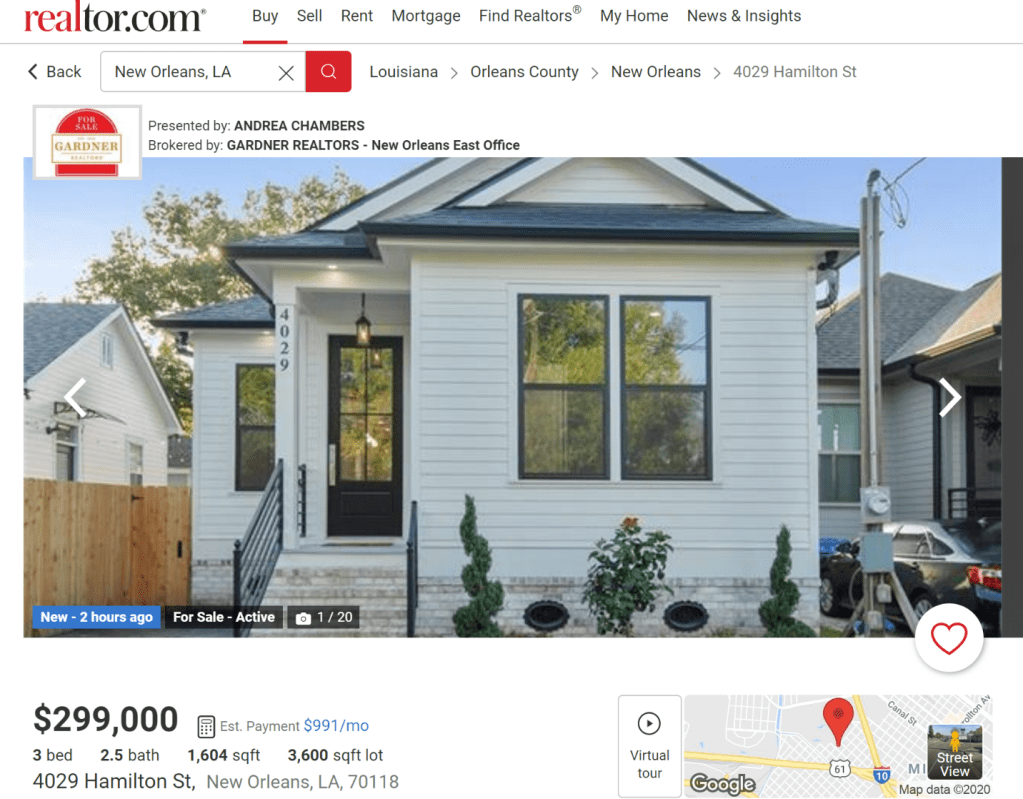
Just for comparison here is a listing for a new construction home in New Orleans posted on Realtor.com today.
Even at $397K (not including lot cost) one might say the extra money was well spent on energy conservation measures and intended health benefits. One might say that, if the properties hadn’t started deteriorating within a few short years.
By 2015, as most construction concluded, the project had cost almost $27 million. But complaints about the construction and materials used in the homes had already emerged.
These transactions had a philanthropic and environmental and private market component to them. The additional inflow of funds to cover the environmental objectives came in, but the new owners of these properties do not appear to have engaged as critical consumers for the core product. They didn’t check into the materials or the mechanicals or the plans. Just talk to a builder rep if you question whether consumers who build with them hover (daily) to ensure they are receiving what was written up in their purchase agreement. Perhaps due to the power of stardom, or the actual dollars being spent on their behalf, the home-buyers seem to have stepped aside and allowed others to do their bidding. Until as the New Orleans Advocate reports:
In September 2018, homeowners Jennifer Decuir and Lloyd Francis sued Make It Right for what they alleged was deficient construction that caused mold, poor air quality, structural failures, electrical malfunctions, plumbing mishaps, rotting wood and faulty heating, ventilation and cooling.
The dynamics of philanthropy allows for an individual (or group) with extra funds to choose a public need and steer their resources accordingly. The recipients are asked only to consider reciprocating at some future date, should they find themselves in a similar situation. If the courts place the blame on Brad Pitt will that inhibit the flow of goods and services from the wealthy to those in need for fear of liability? Were the end consumers not responsible in a buyer-beware type of way to check out what they were buying? From what the articles (USA Today, NPR), they had owned and maintained homes in the past.
There’s plenty of blame to go around. The architect John C Williams collected $4 million in fees. There were permits and inspectors and building codes. And maybe some blame should end up at the lenders’ door for not questioning the innovative, but untested systems, going into the project. In the end they are on the hook for the paper if a homeowner walks and abandons their property. But mostly, in the for-profit market, the relationship between the developer-builder and the home buyers establish the acceptable combination of durability, green components and price.
The problem wasn’t a lack of intentions. The problem was that the philanthropist-activists bypassed the marketplace and all the small interactions that make it up. The fatal flaw was the thought that with enough money, and passion, all the feedback and tussles between consumers, and inspectors, and building code committees, and brokers, and city planners, and developers, and real estate agents, and electricians,…that all those players interacting in a market setting, just doesn’t matter.
The market continues to shuffled through the consumer choices when judging the environmental impact of products. Standards are set by producers of furnaces and A/C units; power companies offer home energy audits and neighbor consumption comparison; neighbors talk to each other; contractors share incentives; all in the effort to advance a public goal of energy savings. But at each step that goal must be incorporated into the overall integrity of the purchase at hand, or homes will fall apart just like those in the Lower Ninth Ward.
Praise for Brad Pitt remains high, and the contention remains that his intentions were and are completely genuine. It looks, however, as if he will pay dearly for moving toward an ambition without vetting it through the market system. This story shows us that it is not enough to imagine a better world, and poof! It will happen. Progress takes the engagement of all players, giving feedback through action and pricing. Progress depends on markets.
When trying to understand why some goods and services are provided in the private sphere versus the public sphere, let’s consider the history of the Hennepin Ave Bridge. Back when Minnesota was just a territory, full of trappers and prospectors and a military force down the river at Fort Snelling, two entrepreneurs took it upon themselves to get folks across the mighty Mississippi. From MNopedia:
In 1847 businessman Franklin Steele and his friend John Stevens established a rope ferry from Nicollet Island to the western side of the river to help travelers cross.
While the ferry helped initially, an increase in traffic necessitated new construction. In 1851 a bridge was built from St. Anthony to Nicollet Island to make the trek to the island easier for travelers. A short time later Steele and local business leaders took steps to build a bridge that would reach both sides of the river.
On March 4, 1852, Steele and his associates were granted a charter by the Territorial Legislature to build a bridge. The group formed the Mississippi Bridge Company and soon after began planning for a new bridge along the same path as the rope ferry.
The bridge opened to the public in January of 1855. The business partnership of Steele and Stevens charged a toll of 3 cents to the 1450 residents on both sides of the banks to alleviate their $36,000 investment. But there were problems.
The bridge was almost immediately plagued with safety issues. On March 25, 1855, a tornado tore through the area, nearly destroying the bridge. Although it was rebuilt and reopened on July 4, safety and capacity concerns persisted throughout its lifetime that eventually led to its being replaced.
After 14 years, the bridge changed ownership from private to public ownership.
In 1869 the charter the Mississippi Bridge Company held on the bridge expired and Hennepin County paid the company $37,500 to assume ownership. The toll requirement continued until the bonds sold to buy the bridge were paid off in 1872.
This bridge, as well as all other highways and bridges in the state, continue to operate as part of a public transportation infrastructure system. Why some products are deemed private and some are public is a topic this blog will continue to explore. Products and services that meet the demands of numerous groups, whether business groups, family groups, associational groups and so on, in conjunction with a need for some measure of public safety seem better suited to the public sphere.
Consider the life story of Mrs. Czech, featured as the rhetorical centerpiece of an influential article published in The Survey in 1916 by Emma Winslow, home economist at the New York Charity Organization Society. Mrs. Czech was a widow who, for three years after her husband died, “was not obliged to use money in any way.” A charitable society provided her and her six children with food and clothing and paid their rent and insurance. And yet, despite such “theoretically…perfect care,” the Czechs floundered. The mother “apparently…had no interest in the appearance of her home or of her children.” Nor did she care about their food. Soon, the children’s health deteriorated, their faces becoming “sallow and pasty.” At this point, the charity society decided to shift the method of relief into a weekly cash allowance, instructing Mrs. Czech “to do her own buying.” Soon housekeeping “became a delight,” the children’s health flourished, and the formerly indolent widow turned into a “remarkable domestic…economist.” And all because she now had the cash “to buy what she wanted when she wanted it.”
In this vignette, taken from The Social Meaning of Moneyby Viviana A. Zelizer, a family finds themselves in need of assistance. They have lost their wage earner and hence their source of funds. Instead of replacing the funds, however, the charitable organization replaces the mom’s job by doing all the choosing and purchasing for her. They in effect removed her from the trade necessary to complete her social objective to care for her family.
Even with the best intentions, the desire to release individuals or groups from the work attached to their role in the production of their public objective, causes market failure. And it is by far the most prevalent and damaging market failure in the social sphere.
An exchange between women on the streets of Lisbon some forty-five years ago seems straightforward enough. Very free market! But there is more to the story than the image of one women clutching a porte-monnaie and another wrapping the fresh catch of the day. More than likely these two have known each other for years, perhaps the families have known each other for generations. Over those many interactions standards have been set, expectations established and met, and even some pricing adjusted if one had run into hard times. The social component of this exchange is in that picture too.
When I was a girl, I used to love the chaos of open markets like the Addis Mercato. The mish mash of it all. The skill of barter. My parents always ask for local advise before heading out in order to know the going ‘foreigner’ rate of things. That way we’d at least have some idea of an appropriate price to pay. A market brings together buyers and sellers who agree to an exchange. In this setting it is money in trade over a rickety wood stall for some durable good.
With Covid on everyone’s mind, it was recently asked: “What is the nature of a marketplace for a vaccine?” When it comes to health and saving lives we always get a little squeamish about accounting for things, for seemingly putting dollars to lives. But even if only in a hazy subconscious way, people still make these choices which involve resources.
Who is at the piazza for vaccines? The buyer is the worldwide citizenry, starting with the most susceptible and to those who have the greatest chance of being a spreader, to everyone else. Who benefits from the trade? Everyone. Who is the seller? Here’s the tricky part. The sellers are a collaboration of the scientific facilities who research and develop, the drug manufactures and some type of government agency.
If you question whether these are linked by an overlay, try to separate them. The researchers have knowledge but need funding. The pharmaceuticals can produce with knowledge, but can’t afford the researchers. The government representing the will (in theory) of the people and can use their money to pay the researchers, but is denied the ability to be a producer as history has shown that this is best left to the pharmaceuticals. But something is different in the mechanism of the interaction between these three. They are operating in a separate economic sphere.
So we’re stuck with all of them. Mother Nature has done a great job of providing the researchers the need they usually have to demonstrate. Hence, the funding process has gone well. Now the two other collaborators are weighing their investments, risks, and tradeoffs. The formal representatives of the people know the profits to the people from a fast turn around on a vaccine is high. There is a large and immediate benefit from scaled-up vaccine production.
Something is different for the pharmaceuticals. For although they share the umbrella objective of providing lifesaving Covid-19 vaccines, their stand alone sphere of economic activity is one that operates in the realm of the profit motive with assurances of property rights. Remember that, at least in the US, they do business in the private market sphere by design. Their incentives and risks are no longer in step with the two public sphere entities.
At these juncture points, where the two systems meet, it can be uncomfortable. At these seams, resources can by hijacked, which makes people warry. And this is true through the ever cascading layers of economic behavior within a system. Which explains the necessity to pull the players apart and figure out which stage is hosting their production.
If the women of Lisbon could figure it out, I’m sure we can too.
The question of the day is what is the nature of work. Not work for which you receive a salary, but the work necessary for public production. Bill Green, professor of history at Augsburg College ponders this question in an interview with Cathy Wurzer of MPR. Here, the topic at hand is the toppling of a statue of Christopher Columbus. But it is his inquiry into determining whether such activity counts as work or whether there is some other commitment which is required to, in this case, neutralize the negative historical impact on minorities, which is interesting.
Without a definition, the wild west of interpretation has been unleashed. The loudest claimants promote their version: You must march on Washington! You must forego your police force! You must forego your career (as in the case of senator Al Franken). But did any of these three events materially contribute to the advancement of a single minority or woman? Or could we equate them more readily to exposing, hence a marketing of sorts, of the issues.
Why even does it matter whether we give work some shape, outline its boundaries? Let’s take the Women’s march on Washington in early 2017. It is reported that 470,000 people showed up in our nation’s capital. Many more across all the states. But we can assume that say 400,000 in Washington traveled to get there. So let’s say the whole weekend took 48 hours of their lives. Now say the median hourly wage in the US is $18.5/hour. So for two days of work these folks contributed the equivalent of $296 x 400,000=$118.4million. Use your own numbers, but it is a lot of cash.
The women marching in the photos don’t look destitute or oppressed. They are not themselves in need. They are there on behalf of others. And I believe their intentions were sincere. They undoubtedly felt this was work towards their cause. It just seems like they could have better used the $118.4 million to secure housing for a single mom and her elementary school child, for instance. Or part of that $118.4M could have guaranteed vocational training and mentorship for girls coming out of a foster home setting. There are so many gaps in the chain of needs.
It reminds me of the foreign aid packages from years gone by. They were intended to feed the poor, but the poor rarely saw a trace of it. The work done in a public sphere requires the parties to touch, to interact, to engage in a transaction of a public nature. All this cancelling and marching and firing is just drumming up a bunch of grandstanding.
Today the Nobel Prize in economics was presented to Paul Milgrom and Robert Wilson who developed auction theory and auction design. The Nobel Prize site provides an excellent background for understanding their work. Interestingly, this includes a differentiation between the common value of a good and the private value as a key feature. Where the definition of a private value is defined as one achieved when the bid decision is made independently of any other bidder in the auction.
The 1996 Laureate in Economic Sciences, William Vickrey, established auction theory in the early 1960s. He analysed a special case, in which the bidders only have private values for the good or service being auctioned off. This means that the bidders’ values are entirely independent of each other. For instance, this could be a charity auction for dinner with a celebrity (say a Nobel Laureate). How much you are willing to pay for such a dinner is subjective – your own valuation is not affected by how other bidders value the dinner. So how should you bid in this type of auction? You should not bid more than the dinner is worth to you. But should you bid lower, perhaps getting the dinner at a lower price?
The explanation goes on to describe the theory of common value.
Entirely private values are an extreme case. Most auction objects – such as securities, property and extraction rights – have a considerable common value, meaning that part of the value is equal to all potential bidders. In practice, bidders also have different amounts of private information about the object’s properties.
The portion of the bid that is devoted to the common value is based on a projection of what the bidder feels others will pay. Thus to have better knowledge is advantageous. Here the familiar diamond trader example if used.
Let’s take a concrete example. Imagine that you are a diamond dealer and that you – as well as some other dealers – are contemplating a bid on a raw diamond, so you can produce cut diamonds and sell them on. Your willingness to pay only depends on the resale value of the cut diamonds which, in turn, depends on their number and quality. Different dealers have different opinions about this common value, depending on their expertise, experience and the time they have had to examine the diamond. You could assess the value better if you had access to the estimates of all the other bidders, but each bidder prefers to keep their information secret.
Now if the diamond traders are from a tight knit community, say of the Jewish faith, than all those in the faith are included in the advantageous bidding environment. The information is public information within the group, private to those at the exterior. This type of diamond trader group is used by sociologist James S. Coleman in his famous treatise from 1988,Social Capital in the Creation of Human Capital.
Wholesale diamond markets exhibit a property that to an outsider is remarkable. In the process of negotiating a sale, a merchant will hand over to another merchant a bag of stones for the latter to examine in private at his leisure, with no formal insurance that the latter will not substitute one or more inferior stones or a paste replica. The merchandise may be worth thousands, or hundreds of thousands, of dollars. Such free exchange of stones for inspection is important to the functioning of this market. In its absence, the market would operate in a much more cumbersome, much less efficient fashion.
Coleman stresses the benefits of assurances. Assurance which can be given due to the greater knowledge of the stones, their quality and source of origin. Coleman says:
Observation of the wholesale diamond market indicates that these close ties, through family, community, and religious affiliation, provide the insurance that is necessary to facilitate the transactions in the market. If any member of this community defected through substituting other stones or through stealing stones in his temporary possession, he would lose family, religious, and community ties
Coleman concludes that there is value in this. His view is that value lies in the social ties, or the social network, which parties to the transaction are able to access.
The particularly interesting feature of this system is the economic role of ultra-Orthodox Jews. The ultra-Orthodox provide critical value-added How Community Institutions Create Economic Advantage 415 services that add significant efficiency to the system of exchange. They work as skilled diamond cutters whose polishing increases the sale prices of stones, and they play the essential role of middlemen brokers who match certain stones with the buyers who most value them. Their unique credibility provides the Jewish merchants with a comparative advantage over rival merchant groups that lack such community foundations, and their role identifies limitations to public contract enforcement that persist even in developed economies. When courts fail, community institutions can arise to fill their place.
Here’s what we know from these three uses of the Jewish diamond traders example. All three feel the group has created some type of value—not to anyone individual but a blanket of value across the group. This value has something to do with how the group is connected, how the information flows through its membership. And that there is a commitment to maintain a standard of enforcement.
What is exciting about Milgrom and Wilson’s differentiation of private and common value is that there is a tie-in to price. An auction bring buyers and sellers into a marketplace. And the values that these two new Nobel Laureates observed reflect activity of a private nature and that of a common nature.
As pointed out in previous posts the categorizing of goods as either private or public (or club and common) is inadequate. My first post here introduces the idea that a haircut can have a public (common) component. And I also wrote a post about national defense as there are many examples of how this public good was used to the benefit (privately) of a sub-group. The long and the short of it is that goods are goods. It is how they are employed, by what types of groups, which determines the portion of their price derived from a private sphere and that derived from a public sphere.
Marginal Revolution University is an incredible source of economic knowledge. In addition to the course work there are videos and games. Here’s one designed to help distinguish between public goods, private good, common goods and club goods. At the end of the game there is a cheat sheet of how to classify these goods and services.
Pure Private Goods/Services (excludable, rival) ● Haircut ● Pizza ● Website design ● Table service at a restaurant ● Snuggie ● House
Club Goods/Services (excludable, nonrival) ● Netflix ● Amusement park ● Uncongested toll roads (highway) ● The movies ● YMCA membership
Common Goods (nonexcludable, rival) ● Busy city street ● Hospital E.R. ● Tuna in the ocean ● The meadow where your sheep graze ● Wildlife ● Forests
Pure Public Goods/Services (nonexcludable, nonrival) ● Wikipedia ● National defense ● Uncongested city street ● City fireworks ● Air to breathe ● Google ● Asteroid defense
To understand the economic arrangement I talk about in this blog, these categories have to be rearranged. I ask people to consider that there are two natures to every product: public and private. The nature is dependent upon who, or which group, has access to the goods.
Let me give you an example. A haircut seems like a pretty straightforward private good. The exchange is between two individuals where the customer clearly owns the hair. But what if the haircut was given to disadvantaged kids in an elementary school by a barber who was providing the service as a gesture of community involvement?
The purpose of the activity is to enhance a child’s self esteem and in doing so increase their productivity at school. The barbers work for free so no money is exchanged to make this a private transaction. There are no production reports, nor does this get measured as a part of GDP. This service is done as a public service not a private transaction. Mind you not just anyone can get the free haircut. Only the kids at the elementary school in question. Everyone else must pay. So the public nature has to be attached to that grouping: it is a public good for the elementary school kids.
This is the reason a haircut cannot be classified exclusively as a private service. In due time, I will sort through this whole list of goods and services to convert you to the new classifications of public and private! In due time.