
I assert here at home economics that there is a private and public side to every transaction; that the course through which the action travels varies if it is primarily tapping private concerns or public concerns.
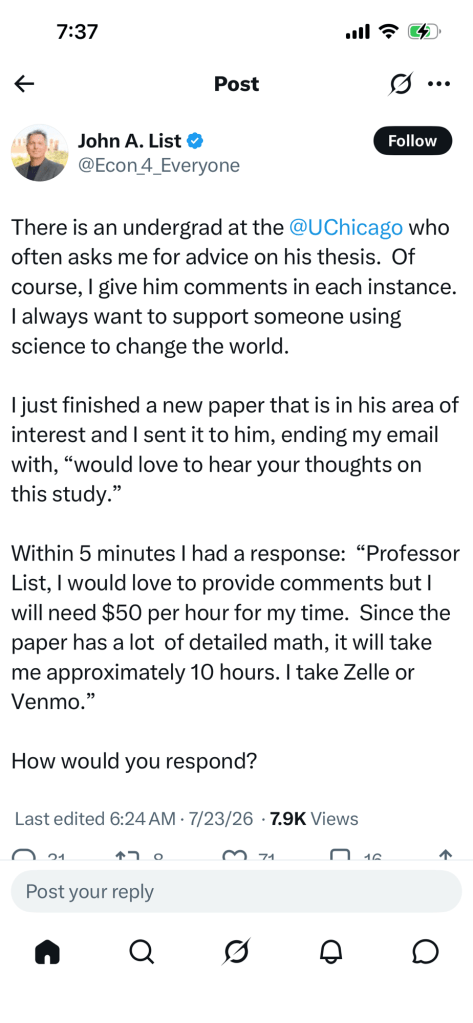
In this vignette, Professor List asks his audience for their reaction to whether he should pay a student to review his work. The underlying question is whether the student ought to donate his time or treat the request as a paid position—List proposes $50 an hour. The answers that follow are revealing: they disclose the kind of relationship people assume exists between professor and student.
The student is no longer enrolled in the professor’s class, yet one can reasonably infer they still occupy a mentor–mentee relationship. The mentor’s role is to educate and guide. The mentee’s corresponding duty is not to waste the mentor’s time and to make good use of the guidance offered. In this framing the flow of value is unidirectional: a gift of a private good to a private recipient.
An alternative reading treats them as equal members of the college. As participants in the same intellectual community they both benefit by reviewing each other’s work; the knowledge that results is a kind of public good produced by reciprocal sharing. No money changes hands, and the intellectual capital remains with both parties.
A third possibility is the one the student himself seems to have inferred: that the request is private and transactional. Once the exchange is framed that way, the student may collect his fee and then find himself quietly excluded from future opportunities for genuine intellectual exchange. Silent exclusion can be the most costly outcome of all.
But to answer John List’s question one must first set up the problem and identify the groups.


