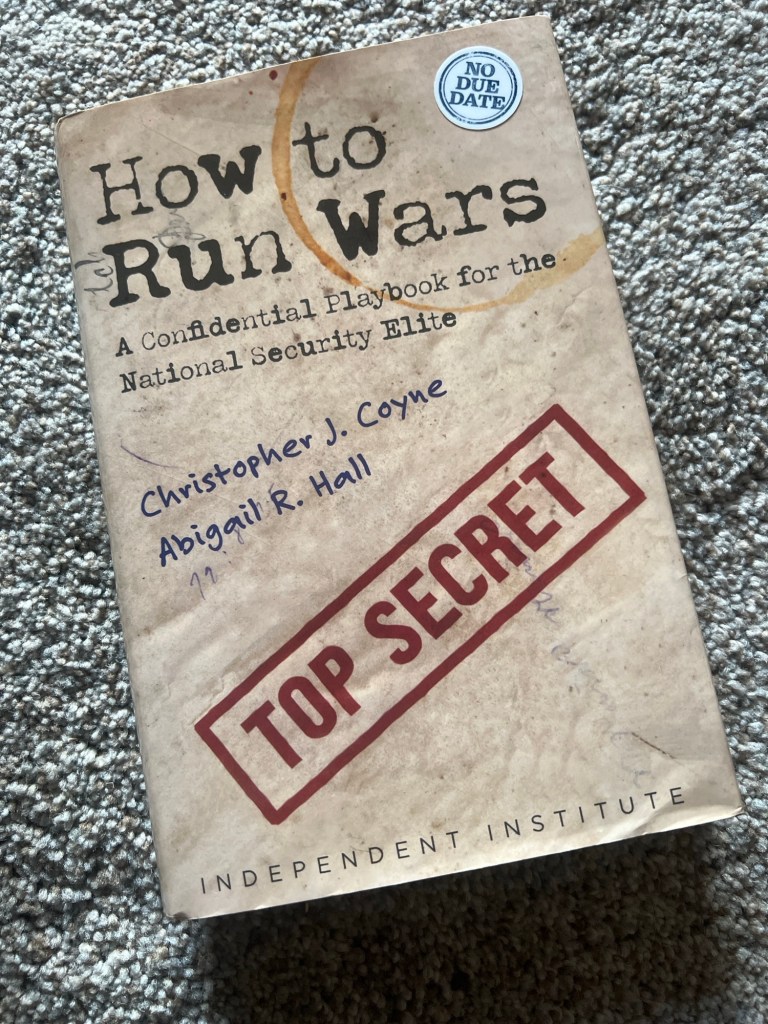
Just finished How to Run Wars: A Confidential Playbook for the National Security Elite by Chris Coyne and Abigail Hall (Independent Institute, 2024).
Presented as a satirical “leaked” insider handbook, the book outlines a practical playbook of tactics used by national security elites — from curating public narratives and managing media to commandeering economic resources and handling dissent. The satire is there, but the real strength is in the clear framework it provides for understanding persistent incentive problems.
What stands out is how the playbook’s structures apply far beyond defense. They highlight classic patterns:
- Dispersed costs and concentrated benefits — taxpayers or policyholders bear small individual burdens while a few insiders gain significantly.
- One-buyer dynamics (monopsony power), as seen in DOD procurement where slow bureaucratic bargaining and asymmetric information routinely drive costs higher.
- Asymmetric information where agents (contractors, administrators, regulators) know far more than the principals funding the system.
These same dynamics appear in everyday arenas. Think of insurance roof replacements after storms: third-party payers, inflated claims, and higher settlements become the norm. Or regulatory frameworks meant to “protect” the public that end up giving rule-makers and insiders significant unmonitored leeway.
The book explicitly draws parallels to the COVID response — narrative coordination across government, media, and Big Tech to manage information flow, along with efforts to suppress alternative views. It shows how crisis tools and incentive structures migrate easily from foreign policy to domestic ones.
The broader takeaway is powerful: employing the analytical structures revealed in this playbook gives us useful methodologies for spotting and dissecting these incentive distortions across any policy domain — healthcare, finance, disaster response, regulation, and beyond. Once you see the pattern, it becomes much harder to miss.
Strongly recommend for anyone interested in public choice, incentives, and why good intentions so often produce predictable problems.

 Home Economics