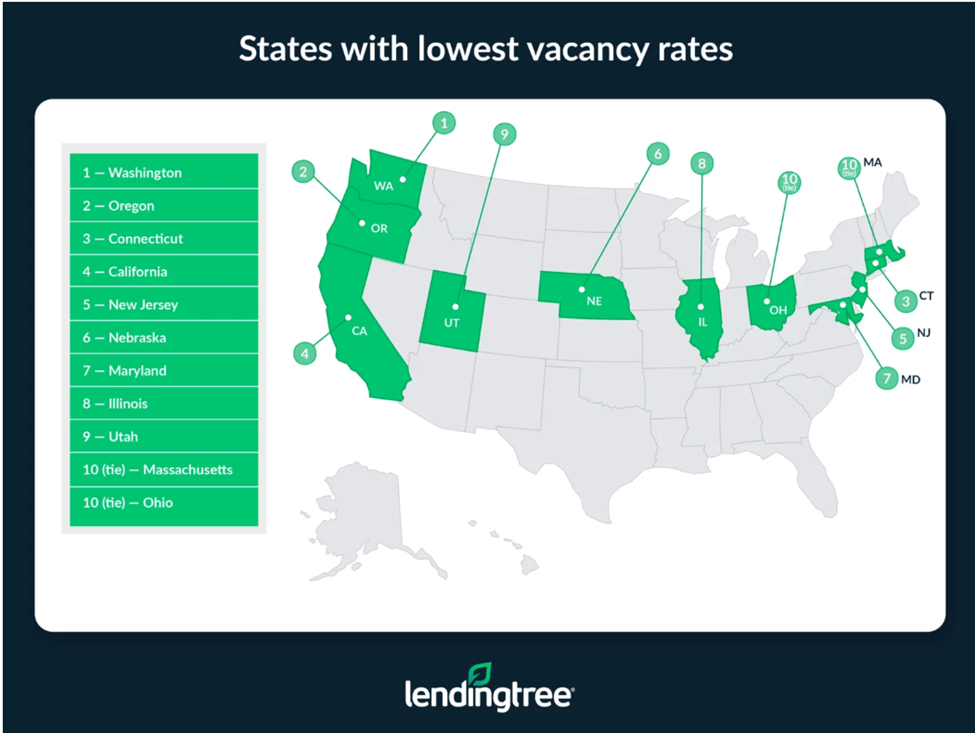
Some claim a housing crisis is underway, but I’m not so sure. If the pressure for homes were severe, one would expect most properties to be occupied, leaving others stranded without a place to go. Vacancy rates provide us with additional information. An article by LendingTree, 14.9 Million Homes Are Vacant in the US — Here Are the States With the Highest Vacancy Rates, provides a great overview of the topic.
Vacancy rates differ significantly depending on where you look in the country. If you’re looking at Maine, you’ll find the highest vacancy rate in the country — 21.09% (157,467 vacant homes), according to our analysis of the U.S. Census Bureau 2023 American Community Survey (ACS) with five-year estimates. Following Maine at the top is Vermont, with a 20.06% vacancy rate (67,606 vacant homes), and Alaska, with an 18.24% vacancy rate (59,745 vacant homes).
Together, these three states account for nearly 285,000 vacant homes — out of 14.9 million vacant homes nationwide.
Nationally, the vacancy rate is much lower than that of these three states, with the U.S. average sitting at 10.43% — a figure that translates into nearly 15 million vacant homes. While that may sound like a lot, it may not feel like it if you’re searching for a place to live. That’s because not all of those properties are available to rent or buy.
In addition to seasonal and vacation homes, others are classified as vacant because they’re in transition — those that are rented but not occupied and sold but not occupied. Homes for migrant workers, which they occupy during crop season, are also classified as vacant.
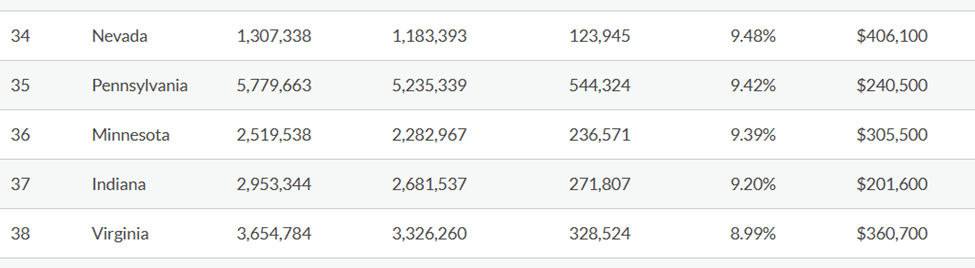
Minnesota, as is often the case, is just average. There are 236,571 homes vacant, which, in percentage terms, is 9.39%
The article cites a list of reasons why a home could be vacant. It might be a second home or vacation property. It might be in a transition state from either a remodel or a relocation of residents. Sometimes people hang onto properties for emotional reasons, such as a family tie to the land.
But note, in any case, that there is a variation between the states. Real estate is local. National generalizations about the state of housing are often dumbed down and not particularly helpful.

 Home Economics