I sat through an interesting presentation today at the Federal Reserve Bank of Minneapolis—a striking glass and steel building on the edge of the Mississippi River. The commentators all shared angles on the ambitions for affordable housing in their respective areas of the country. The very pragmatic Jenny Schuetz with Brookings is speaking here.
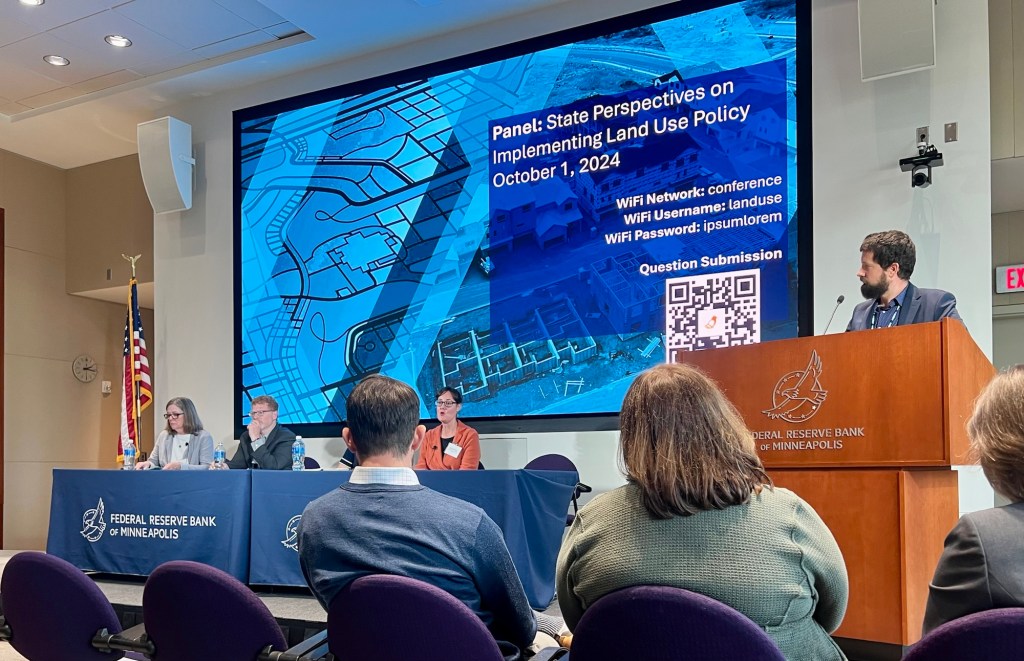
One of her messages is to pick a reasonable goal, such as downsizing parking requirements, and get that passed. Massive bills packed full of ideas are interesting only in theory.
With simplicity in mind, here’s a product idea meant to steer resources in the right direction. A few days ago I panned the idea of swaying behavior through signage- Will Signs Work? The lack of incentives is what is missing here.
Let’s think of it as a model. The man in the middle, we’ll call MN1. After all, the driver of all intentions in this endeavor is MN1. This is the person we desire to receive resources. Without this person, there is no need for the non-profit to exist to come to their aid. Without MN1, the drivers would not be tempted to pull to the side at a busy intersection and pass a few dollars through the window. The model takes the perspective of MN1.
What does MN1 want? In the news clip, the panhandler said he hoped to earn $20-30 from a day on the curb. Now we know the amount of incentive necessary to show up. What do the motorists want? They wish to satisfy their impulse to come to the aid of a fellow human in need. To give directly is very satisfying. What do the non-profits want? They wish the panhandlers would come to their sites for the services they are trying to administer. Their livelihood is based on attracting MN1’s.
If the motorists could purchase a voucher for $50 which the MN1s could redeem at the non-profits, all actors achieve satisfaction. The motorists pass aid directly into the hands of the panhandler. The cash incentive should drive MN1s to contact the non-profit. This allows face time to sell their services. Furthermore, for vouchers lost or unclaimed, the non-profit earns the face value of the donation.
The MN1 folks are able to come away with cash and hopefully additional avenues to services that alleviate their plight. The motorists appease their need to help while donating a nice amount to the local non-profit of their choice, a choice with the added benefit of a screening process. The non-profit has customer leads showing up at their door while receiving additional donations.
What should the voucher be called? A Twenty-Bucker?


 Home Economics