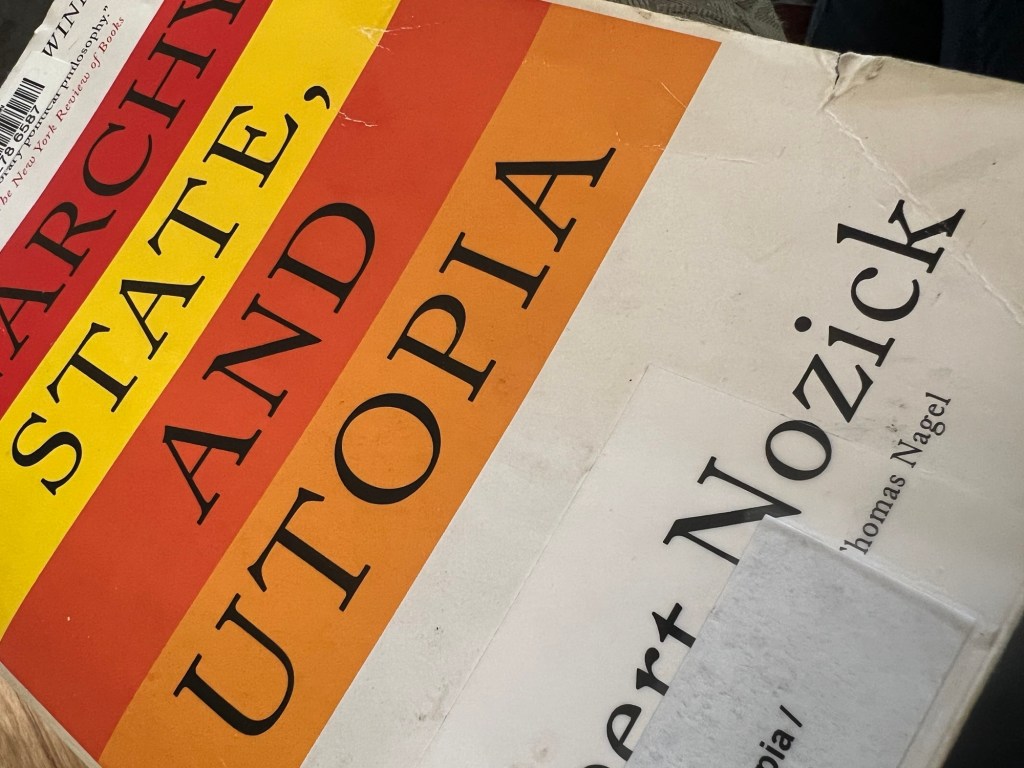
Nozick is a lesser know political philosopher who wrote Anarchy, State and Utopia in 1974. It was offered as a response to John Rawl’s theory of justice. One point of contention revolves around different methods for redistributing resources to the least advantaged. Should this be a top down imposed structure or spontaneously emerge from the churning motion of voluntary action from below?
Some fear individual action is inadequate if left to the individual. Hence the need for control. In this passage Nozick captures the essence of individual action toward communal goals. The delight of it secures its success.
Consider the members of a basketball team, all caught up in playing basketball well. (Ignore the fact that they are trying to win, though is it an accident that such feelings often arise when some unite against others?) They do not play primarily for money. They have a primary joint goal, and each subordinates himself to achieving this common goal, scoring fewer points himself than he otherwise might. If all are tied together by joint participation in an activity toward a common goal that each ranks as his most important goal, then fraternal feeling will fourish. They will be united and unselfish; they will be one. But basketball players, of course, do not have a common highest goal; they have separate families and lives. Still we might imagine a society in which all work together to achieve a common highest goal. Under the framework, any group of persons can so coalesce, form a movement, and so forth. But the structure itself is diverse; it does not itself provide or guarantee that there will be any common goal that all pursue jointly. It is borne in upon one, in contemplating such an issue, how appropriate it is to speak of “individualism” and (the word coined in opposition to it) “socialism.” It goes without saying that any persons may attempt to unite kindred spirits, but, whatever their hopes and longings, none have the right to impose their vision of unity upon the rest.

 Home Economics