It turns out the gifted writer behind all the stories of everyday people navigated social complexities had a little philosopher in him as well. He wrote an essay in 1933 entitled Arguement of Phalanx. Although it is difficult to get a copy of the unpublished essay, a few writers reference it in their work. In the essay he develops a man/group theory.
The ideal group formation, in the writer’s view, is one in which the members act as individuals and at the same time contribute creatively to the formation of a harmoniously integrated whole.
John Steinbeck’s Phalanx Thory, by Marcia Salazar
I wasn’t familiar with the term but I’m not surprised that it denotes this military formation.
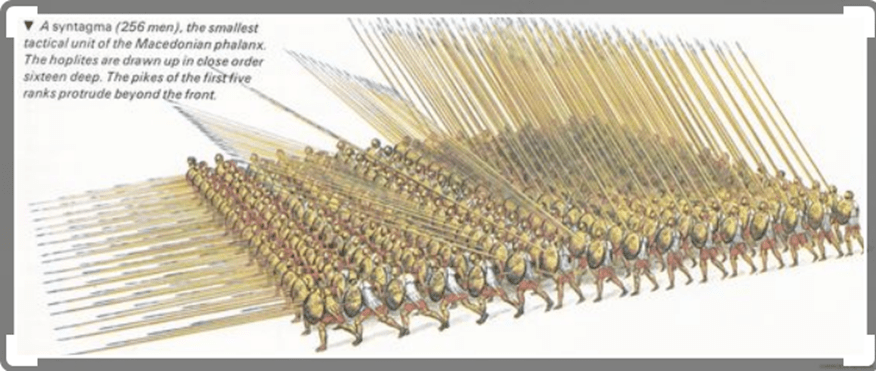
The concept describing what a group of individuals, working toward a similar objective, becomes as a new entity is apparent once you know the the term. He often paints out the different and usually stronger capabilities of individuals who come together in his novels. The fine shading between the groups is particularly clear in In Dubious Battle. Published three years after the essay was written, it almost seems like a canvas designed to illustrate his point.
From a previous post:
In the following few pages Dr. Burton talks about group-men. “I watch these group-men, for they seem to me to be a new individual, not at all like a single man. A man in a group isn’t himself at all: he’s a cell in an organism that isn’t like him any more than the cells in your body are like you. I want to watch the group, and see what it’s like.”
Perhaps Steinbeck didn’t like to be associated with the hairsplitting of philosophical thought. But if Phalanx enters mainstream usage as a core component of social exchange, he may have to accept his fate.

 Home Economics